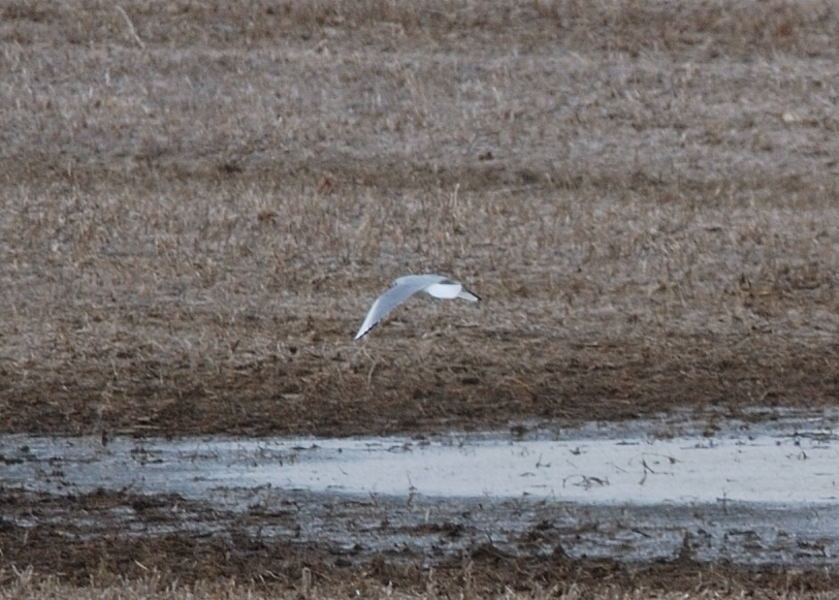
After finding out from Devich Farbotnik and Jason Horn that the Snowy Plover was still present at Presque Isle State Park, I decided to take the long drive out to hopefully see it. Unfortunately because of an appointment that I couldn't cancel, I wasn't able to leave until the afternoon. I picked up Rick Wiltraut at Jacobsburg State Park and we were on our way at 1:00. Both Rick and I had tried for this bird twice before and came up empty both times. Would the third time be the charm?
Six hours and a few thunderstorms later, we parked and headed out to Gull Point with only about two-and-a-half hours of light left. Thankfully, soon after reaching the observation platform, Rick spotted the 'little wind-up toy' on a sandbar. With a new state bird added to our memories, the pressure was off and we were able to enjoy it for at least an hour before sunset. A nicely-colored American Avocet was also there. We took a lot of photos of the plover, especially when the bird flew to the pool nearest the tower.
While scoping the other birds, I spotted a large shorebird that, at first glance, I thought was a godwit but turned out to be a Willet. Soon after, a Bald Eagle stirred up all of the gulls as it flew by.
A rain shower was heavy enough to send us down underneath the tower for a while. After it subsided and we went back on top, Rick spotted a Whimbrel that had just dropped in.
So in a little over an hour, we had seen a Snowy Plover, an American Avocet, a Willet, and a Whimbrel----all exceptional finds in PA. Other birds present included 2 Short-billed Dowitchers, Common and Caspian Terns, Purple Martins, and Bank Swallows. At sunset, we made the long hike back out to the car. A few American Woodcocks took off from the trail along the way. A Willow Flycatcher and Brown Thrashers were also noted. We got back home at 4:15 AM, 782 miles later, tired but happy at the same time. More photos are posted on my Pennsylvania Notables Album.
Thursday, July 3, 2014
Tuesday, June 24, 2014
Common Raven nest in Bethlehem ~ June 23, 2014
You may remember reading reports of Common Ravens being seen on and around the 'steel stacks' at the old Bethlehem Steel plant in Bethlehem. Some people speculated that they might be nesting somewhere in the vicinity. While having a family dinner at my parents' house, I asked my daughter's boyfriend, who happens to work at the Sands Casino, if he happened to know that the Peregrine Falcons had three young and were about to fledge. He told me that he did and that he also noticed a huge nest inside one of the buildings next to the 'steel stacks' and asked if eagles nested inside buildings. That peaked my interest. I said that I was planning to go down and check out the Peregrines and asked him if there was a way to get some photos of it. He told me to give him a call the day I planned on going there and he would get me into the building. Obviously, this late in the year, the nest was empty, but I took several photos of the nest and the debris underneath.
To give an idea of scale, the cross beams under the nest are around 18-24 inches high.
When I mentioned it to Rick Wiltraut, he mentioned that ravens typically line their nest with deer hair. That pretty much assured that this was a ravens' nest since there were, indeed, patches of hair underneath it. It will be interesting to see if they return for the next breeding season.
To give an idea of scale, the cross beams under the nest are around 18-24 inches high.
When I mentioned it to Rick Wiltraut, he mentioned that ravens typically line their nest with deer hair. That pretty much assured that this was a ravens' nest since there were, indeed, patches of hair underneath it. It will be interesting to see if they return for the next breeding season.
Saturday, April 5, 2014
"Common" Teal Hybrid in Northampton County ~ April 5, 2014
Mike Schall called me about a Green-winged Teal that appeared to be a hybrid between a "Common" Teal (the Eurasian form) and a Green-winged Teal of the American race. The bird had the white horizontal stripe along the wing, pointing to a "Eurasian" or "Common" Teal, but it also had the vertical white spurs on its sides, pointing to our "American" Green-winged Teal. It was being seen in a flooded field just north of Newburg between Routes 191 and 946 with ten 'traditional' Green-winged Teal. I got there and took the following photos of it. It was the first hybrid like this that I had ever seen.
I was lucky enough to get two flight photos of it showing the brigher, whiter bars on the wings compared with the duller, buffier bars of the "American" race, so it definitely had "Eurasian" blood.
There was also a Blue-winged Teal there (obvious near the top of the above flight photos) along with four Bonaparte's Gulls.
I was lucky enough to get two flight photos of it showing the brigher, whiter bars on the wings compared with the duller, buffier bars of the "American" race, so it definitely had "Eurasian" blood.
There was also a Blue-winged Teal there (obvious near the top of the above flight photos) along with four Bonaparte's Gulls.
Friday, January 17, 2014
Waxwings and Robins Invade the Yard ~ January 16, 2014
This afternoon, it was fun to watch as the yard was being invaded by about a hundred Robins while, at the same time, around 30 Cedar Waxwings descended into the Crabapple and Mulberry trees. Many of them took turns getting a drink from the waterfall at my tiny pond, which has lately attracted Bluebirds and a Hermit Thrush among the usual winter suspects. Lugging all those rocks into place has been well worth it. I was able to get a few satisfying photos of them through the window.
Sunday, December 29, 2013
Bethlehem - Easton - Hellertown C.B.C. ~ December 28, 2013
This was one of those days that you just can't accurately describe or imagine unless you were there. I was lucky enough to have Jason Horn, Billy Weber, and Stephen Kloiber along with me to do my section of the Bethlehem - Easton - Hellertown C.B.C. I have been covering the Nazareth Quarry and its surrounding Hollo Road pines area (also formerly known as the Twin Ponds Rod & Gun Club) since the 1980's. Over the past several years, the quarry has been a magnet for the wintering numbers of Snow Geese in our area. Christmas Bird Count totals of 20,000 to 30,000 Snow Geese have become the norm.
Saturday's weather was near the best we could have hoped for----no precipitation and very little or no wind. Scoping birds from the top of a quarry for several hours in precipitation or with a cold wind blasting you in the face is no fun. I have spent a few of those days trying to hold the scope steady while your eyes tear up, so things were looking good when we met early enough to do some owling. Although the machinery noise from the adjacent cement mill make listening tough, we did manage to get at least one Eastern Screech-Owl and a Great Horned to respond. As daybreak approached, a Great Blue Heron took flight.
We then went over to the quarry to get a good estimate on the number of Snow Geese that filled the entire western two-thirds of it before they took off to feed in the neighboring fields. This is also the best chance at picking out a Ross's Goose, which equates to finding a needle in a huge, white haystack. Billy picked out the first Ross's and, after a lot more searching, a really good total of four birds were found. Stephen picked out a Peregrine Falcon sitting on one of nearby buildings. When one of three adult Bald Eagles that we would see there decided to soar over the quarry, the masses of Snows lifted off, making a sound similar to several helicopters taking off at once.
The guys and I continued to scope the quarry, picking out a Red-breasted Merganser, 2 Lesser Scaup, and 2 Pied-billed Grebes among the expected numbers of American Black Ducks, Ring-necked Ducks, Buffleheads, Common Mergansers, Ruddy Ducks, and American Coots. Billy spotted a pair of Common Ravens soaring over the north side of the quarry.
Checking the east end of the quarry produced a Greater White-fronted Goose and 4 Cackling Geese among the roughly thousand Canadas. It's interesting that each year the Canada Geese claim the back half of the quarry and the Snows inhabit the large end, a goose version of segregation.
Walking the wooded area with the two ponds, we found two Hooded Mergansers and a Belted Kingfisher on one of the ponds in addition to a Yellow-bellied Sapsucker, a Brown Creeper, two each of Golden-crowned and Ruby-crowned Kinglets, 2 Hermit Thrushes, 4 Yellow-rumped Warblers, Swamp and American Tree Sparrows, and 3 Red-winged Blackbirds.
While making one last check of the quarry, we noticed increasing numbers of gulls flying in and overhead. They included 2 Iceland Gulls and a Great Black-backed Gull among a number of Lesser Black-backeds and Herrings. We left the quarry around noon with over 60 species!
On the way down to the Chain Dam on the Lehigh River, we found another Peregrine Falcon pursuing a large flock of Starlings and picked up a White-crowned Sparrow and one Savannah Sparrow. Working our way down along the Lehigh to the Forks of the Delaware didn't produce much at all except for the one Common Goldeneye on the Delaware, which added another new species to our total.
On our way back towards the quarry, our good fortune continued when the Snowy Owl that hadn't been reported since last Monday was sitting on a house roof!
As we set up scopes on the Snowy, we noticed skein after skein of Snow Geese that lined the sky from the quarry all the way back to the horizon over the town of Tatamy.
We 'guesstimated' that there were at least 15,000 in view at any given time. The procession continued for over 45 minutes with birds constantly coming as far as we could see. They were streaming through when we got there around 4 PM and were still moving through at dusk. We conservatively estimated more than 200,000 Snows! I would've loved to had a videotape of the whole scene. While all this was happening, the Snowy Owl left the roof and flew directly at us! It passed within eight feet of us and flew across the road, landing on a telephone pole near Hollo Road. Also while there, the guys picked out 7 Northern Pintails and 2 American Wigeon among the geese and 10 Horned Larks that flew across the road. A quick run back to the quarry found it two-thirds full and wall-to-wall with geese with more still dropping in. That was the end to a great day, which netted us 73 species for the day, a C.B.C. record for all of us!
A few photos from the day can be seen in my Local Notables - 2013 Album.
Here are our totals from the day:
Greater White-fronted Goose------------1
Snow Goose------------------------200,000
Ross's Goose-------------------------------4
Cackling Goose----------------------------4
Canada Goose------------------------1,400
Mallard-----------------------------------215
American Black Duck--------------------16
American Wigeon-------------------------2
Northern Pintail---------------------------7
Ring-necked Duck------------------------61
Lesser Scaup------------------------------2
Common Goldeneye----------------------1
Bufflehead--------------------------------14
Common Merganser---------------------27
Red-breasted Merganser-----------------1
Hooded Merganser------------------------2
Ruddy Duck-------------------------------38
Pied-billed Grebe-------------------------2
Great Blue Heron-------------------------1
Turkey Vulture----------------------------3
Black Vulture------------------------------8
Bald Eagle---------------------------------4
Sharp-shinned Hawk---------------------1
Cooper's Hawk----------------------------2
Red-tailed Hawk--------------------------3
Merlin--------------------------------------1
Peregrine Falcon--------------------------2
American Coot---------------------------17
Ring-billed Gull-------------------------560
Herring Gull------------------------------30
Iceland Gull--------------------------------2
Lesser Black-backed Gull---------------24
Great Black-backed Gull-----------------1
Rock Pigeon----------------------------111
Mourning Dove--------------------------14
Great Horned Owl------------------------1
Snowy Owl---------------------------------1
Eastern Screech-Owl---------------------1
Belted Kingfisher-------------------------2
Red-bellied Woodpecker-----------------5
Northern Flicker--------------------------6
Yellow-bellied Sapsucker-----------------1
Downy Woodpecker-----------------------5
Blue Jay------------------------------------7
American Crow-------------------------115
Common Raven---------------------------2
Horned Lark-----------------------------10
Tufted Titmouse-------------------------5
Black-capped Chickadee-----------------8
Brown Creeper----------------------------1
White-breasted Nuthatch----------------2
Carolina Wren----------------------------8
Golden-crowned Kinglet------------------2
Ruby-crowned Kinglet--------------------2
Eastern Bluebird--------------------------6
Hermit Thrush----------------------------2
American Robin------------------------178
Northern Mockingbird--------------------3
European Starling-----------------------90
Yellow-rumped Warbler------------------4
American Tree Sparrow-----------------42
Savannah Sparrow------------------------1
Song Sparrow----------------------------22
Swamp Sparrow---------------------------2
White-throated Sparrow----------------75
White-crowned Sparrow------------------1
Dark-eyed Junco-------------------------21
Northern Cardinal-----------------------18
Red-winged Blackbird--------------------3
Brown-headed Cowbird-------------------4
House Finch-------------------------------7
American Goldfinch---------------------12
House Sparrow----------------------------6
***********************************************
Totals of 73 Species-------------203,262
Saturday's weather was near the best we could have hoped for----no precipitation and very little or no wind. Scoping birds from the top of a quarry for several hours in precipitation or with a cold wind blasting you in the face is no fun. I have spent a few of those days trying to hold the scope steady while your eyes tear up, so things were looking good when we met early enough to do some owling. Although the machinery noise from the adjacent cement mill make listening tough, we did manage to get at least one Eastern Screech-Owl and a Great Horned to respond. As daybreak approached, a Great Blue Heron took flight.
We then went over to the quarry to get a good estimate on the number of Snow Geese that filled the entire western two-thirds of it before they took off to feed in the neighboring fields. This is also the best chance at picking out a Ross's Goose, which equates to finding a needle in a huge, white haystack. Billy picked out the first Ross's and, after a lot more searching, a really good total of four birds were found. Stephen picked out a Peregrine Falcon sitting on one of nearby buildings. When one of three adult Bald Eagles that we would see there decided to soar over the quarry, the masses of Snows lifted off, making a sound similar to several helicopters taking off at once.
The guys and I continued to scope the quarry, picking out a Red-breasted Merganser, 2 Lesser Scaup, and 2 Pied-billed Grebes among the expected numbers of American Black Ducks, Ring-necked Ducks, Buffleheads, Common Mergansers, Ruddy Ducks, and American Coots. Billy spotted a pair of Common Ravens soaring over the north side of the quarry.
Checking the east end of the quarry produced a Greater White-fronted Goose and 4 Cackling Geese among the roughly thousand Canadas. It's interesting that each year the Canada Geese claim the back half of the quarry and the Snows inhabit the large end, a goose version of segregation.
Walking the wooded area with the two ponds, we found two Hooded Mergansers and a Belted Kingfisher on one of the ponds in addition to a Yellow-bellied Sapsucker, a Brown Creeper, two each of Golden-crowned and Ruby-crowned Kinglets, 2 Hermit Thrushes, 4 Yellow-rumped Warblers, Swamp and American Tree Sparrows, and 3 Red-winged Blackbirds.
While making one last check of the quarry, we noticed increasing numbers of gulls flying in and overhead. They included 2 Iceland Gulls and a Great Black-backed Gull among a number of Lesser Black-backeds and Herrings. We left the quarry around noon with over 60 species!
On the way down to the Chain Dam on the Lehigh River, we found another Peregrine Falcon pursuing a large flock of Starlings and picked up a White-crowned Sparrow and one Savannah Sparrow. Working our way down along the Lehigh to the Forks of the Delaware didn't produce much at all except for the one Common Goldeneye on the Delaware, which added another new species to our total.
On our way back towards the quarry, our good fortune continued when the Snowy Owl that hadn't been reported since last Monday was sitting on a house roof!
As we set up scopes on the Snowy, we noticed skein after skein of Snow Geese that lined the sky from the quarry all the way back to the horizon over the town of Tatamy.
We 'guesstimated' that there were at least 15,000 in view at any given time. The procession continued for over 45 minutes with birds constantly coming as far as we could see. They were streaming through when we got there around 4 PM and were still moving through at dusk. We conservatively estimated more than 200,000 Snows! I would've loved to had a videotape of the whole scene. While all this was happening, the Snowy Owl left the roof and flew directly at us! It passed within eight feet of us and flew across the road, landing on a telephone pole near Hollo Road. Also while there, the guys picked out 7 Northern Pintails and 2 American Wigeon among the geese and 10 Horned Larks that flew across the road. A quick run back to the quarry found it two-thirds full and wall-to-wall with geese with more still dropping in. That was the end to a great day, which netted us 73 species for the day, a C.B.C. record for all of us!
A few photos from the day can be seen in my Local Notables - 2013 Album.
Here are our totals from the day:
Greater White-fronted Goose------------1
Snow Goose------------------------200,000
Ross's Goose-------------------------------4
Cackling Goose----------------------------4
Canada Goose------------------------1,400
Mallard-----------------------------------215
American Black Duck--------------------16
American Wigeon-------------------------2
Northern Pintail---------------------------7
Ring-necked Duck------------------------61
Lesser Scaup------------------------------2
Common Goldeneye----------------------1
Bufflehead--------------------------------14
Common Merganser---------------------27
Red-breasted Merganser-----------------1
Hooded Merganser------------------------2
Ruddy Duck-------------------------------38
Pied-billed Grebe-------------------------2
Great Blue Heron-------------------------1
Turkey Vulture----------------------------3
Black Vulture------------------------------8
Bald Eagle---------------------------------4
Sharp-shinned Hawk---------------------1
Cooper's Hawk----------------------------2
Red-tailed Hawk--------------------------3
Merlin--------------------------------------1
Peregrine Falcon--------------------------2
American Coot---------------------------17
Ring-billed Gull-------------------------560
Herring Gull------------------------------30
Iceland Gull--------------------------------2
Lesser Black-backed Gull---------------24
Great Black-backed Gull-----------------1
Rock Pigeon----------------------------111
Mourning Dove--------------------------14
Great Horned Owl------------------------1
Snowy Owl---------------------------------1
Eastern Screech-Owl---------------------1
Belted Kingfisher-------------------------2
Red-bellied Woodpecker-----------------5
Northern Flicker--------------------------6
Yellow-bellied Sapsucker-----------------1
Downy Woodpecker-----------------------5
Blue Jay------------------------------------7
American Crow-------------------------115
Common Raven---------------------------2
Horned Lark-----------------------------10
Tufted Titmouse-------------------------5
Black-capped Chickadee-----------------8
Brown Creeper----------------------------1
White-breasted Nuthatch----------------2
Carolina Wren----------------------------8
Golden-crowned Kinglet------------------2
Ruby-crowned Kinglet--------------------2
Eastern Bluebird--------------------------6
Hermit Thrush----------------------------2
American Robin------------------------178
Northern Mockingbird--------------------3
European Starling-----------------------90
Yellow-rumped Warbler------------------4
American Tree Sparrow-----------------42
Savannah Sparrow------------------------1
Song Sparrow----------------------------22
Swamp Sparrow---------------------------2
White-throated Sparrow----------------75
White-crowned Sparrow------------------1
Dark-eyed Junco-------------------------21
Northern Cardinal-----------------------18
Red-winged Blackbird--------------------3
Brown-headed Cowbird-------------------4
House Finch-------------------------------7
American Goldfinch---------------------12
House Sparrow----------------------------6
***********************************************
Totals of 73 Species-------------203,262
Saturday, November 16, 2013
Black-chinned Hummingbird in PA ~ November 14, 2013
The Gearharts of Shady Grove noticed a hummingbird visiting their feeders. Sandy Lockerman captured and banded the hummingbird, which was determined to be an adult male Black-chinned Hummingbird, only the 2nd documented record for Pennsylvania. The Gearharts graciously opened their yard to birders, so I left at 4:30 AM and got to Shady Grove at around 7:00. Jason Horn and Devich Farbotnik were there and had the bird perched in a bush near the feeders. Eventually, as the temperature climbed out of the upper 20's, the bird soaked up the sun between visits to the feeder. I managed to get a few documentation photos.
Note the curved, blunt primaries, white collar, and notched tail.
It was really tough to get looks, let alone photos, of the purple-edged gorget, but glimpses were given at times during the three hours I was there.
This poor photo is the only one I got showing a part of the gorget's purple edge.
Again, note the curved, blunt primaries and notched tail.
Note the fairly long, fairly straight bill.
It was really tough to get looks, let alone photos, of the purple-edged gorget, but glimpses were given at times during the three hours I was there.
Tuesday, October 29, 2013
Southern California - Arizona Trip ~ October 22, 2013
After constantly reading about the second largest invasion of Blue-footed Boobies in California, the only booby that I hadn't seen, I decided that I had to make the trip, especially given the great chance of finding one of the many birds that were reported. As expected, I got the usual looks and shook my head at the jokes when I told my co-workers that I was going to California to look for boobies. Other remote possibilities included a Plain-capped Starthroat and the possibility of getting much better looks at a Sinaloa Wren, both in Arizona.
I did the very early morning drive to the Philadelphia Airport, boarded a non-stop flight to Phoenix, and was on the road in the rental car by 10:30 AM. I started the 260-mile drive towards California's Salton Sea, taking I-10 west to Blythe, California and then heading southwest on Route 78. Greater White-fronted Goose, Northern Harrier, American Kestrel, Inca Dove, and Loggerhead Shrike were some of the birds seen along the highway. About 25 miles before reaching Brawley, I stopped to marvel at the Algodones Dunes, a huge area of sand about 10 miles wide, 30 miles long, and hundreds of feet high!
The Algodones Dunes east of Brawley, California. Route 78, the thin black strip in the left half of the photo, winds its way up and over the dunes.
The Algodones Dunes east of Brawley, California. For scale, note the white tractor-trailer coming down the road, just below the left center of the photo.
I arrived at the Salton Sea's Obsidian Butte at 3:30, scoped the rock where the birds liked to roost and found it empty. I was beginning to worry a little about being 'skunked' when I noticed the head of a booby appear just above the top of the rock. I grabbed my gear and walked the back edge of the shoreline until I had a clear view of the other side of the rock. There, I had an unobstructed view of eight Blue-footed Boobies! I spent the next three hours watching them and listening to their odd calls. The only downside was that the sun was in an unfavorable position for photos. Still, I managed to get a few 'keepers'.
Eight Blue-footed Boobies on a rock just offshore from Obsidian Butte at the Sonny Bono Salton Sea National Wildlife Refuge near Calipatria, California.
At one point, a Double-crested Cormorant flew in to claim 'King of the rock' and displaced one of the boobies. The bird made a wide circle and returned to the rock.
A Blue-footed Booby comes in for a landing on the rock to join the others.
As sunset neared, a ninth booby joined the others. Other birds noted there included Snow Goose, Eared Grebe, Brown Pelican, Double-crested Cormorant, Snowy Egret, American Coot, Black-bellied Plover, American Avocet, Willet, Least Sandpiper, Long-billed Dowitcher, Heermann's and California Gull, and Caspian Tern.
Nine Blue-footed Boobies showing their dull blue-gray feet.
The Blue-footed Boobies on the rock at sunset. Amazingly, the Salton Sea is about 230 feet BELOW sea level.
A nice sunset put an exclamation point on a great day. At dusk, I headed south to El Centro, hopped on I-8 and headed east to a Motel 6 in Yuma, Arizona.
I did the very early morning drive to the Philadelphia Airport, boarded a non-stop flight to Phoenix, and was on the road in the rental car by 10:30 AM. I started the 260-mile drive towards California's Salton Sea, taking I-10 west to Blythe, California and then heading southwest on Route 78. Greater White-fronted Goose, Northern Harrier, American Kestrel, Inca Dove, and Loggerhead Shrike were some of the birds seen along the highway. About 25 miles before reaching Brawley, I stopped to marvel at the Algodones Dunes, a huge area of sand about 10 miles wide, 30 miles long, and hundreds of feet high!
I arrived at the Salton Sea's Obsidian Butte at 3:30, scoped the rock where the birds liked to roost and found it empty. I was beginning to worry a little about being 'skunked' when I noticed the head of a booby appear just above the top of the rock. I grabbed my gear and walked the back edge of the shoreline until I had a clear view of the other side of the rock. There, I had an unobstructed view of eight Blue-footed Boobies! I spent the next three hours watching them and listening to their odd calls. The only downside was that the sun was in an unfavorable position for photos. Still, I managed to get a few 'keepers'.
At one point, a Double-crested Cormorant flew in to claim 'King of the rock' and displaced one of the boobies. The bird made a wide circle and returned to the rock.
As sunset neared, a ninth booby joined the others. Other birds noted there included Snow Goose, Eared Grebe, Brown Pelican, Double-crested Cormorant, Snowy Egret, American Coot, Black-bellied Plover, American Avocet, Willet, Least Sandpiper, Long-billed Dowitcher, Heermann's and California Gull, and Caspian Tern.
A nice sunset put an exclamation point on a great day. At dusk, I headed south to El Centro, hopped on I-8 and headed east to a Motel 6 in Yuma, Arizona.
Subscribe to:
Posts (Atom)