Tuesday, December 20, 2011

Cackling Geese at Green Pond ~ December 18, 2011

I stopped at Green Pond after doing the Wild Creek / Little Gap Christmas Bird Count and found a few Cackling Geese among about about a thousand Canadas and about 1500 Snow Geese.
A "Richardson's" Cackling Goose with a Canada Goose at the flooded fields by Green Pond, Northampton County. In comparison to the Canada Goose, note the Cackling's much smaller overall size and its more silvery or grayish appearance, shorter neck, stubbier bill, and more vertical forehead, which makes the head look 'blocky'. Another trait that most Cackling Geese show is a white 'chinstrap' that often appears wider and more horizontal at its top edge.

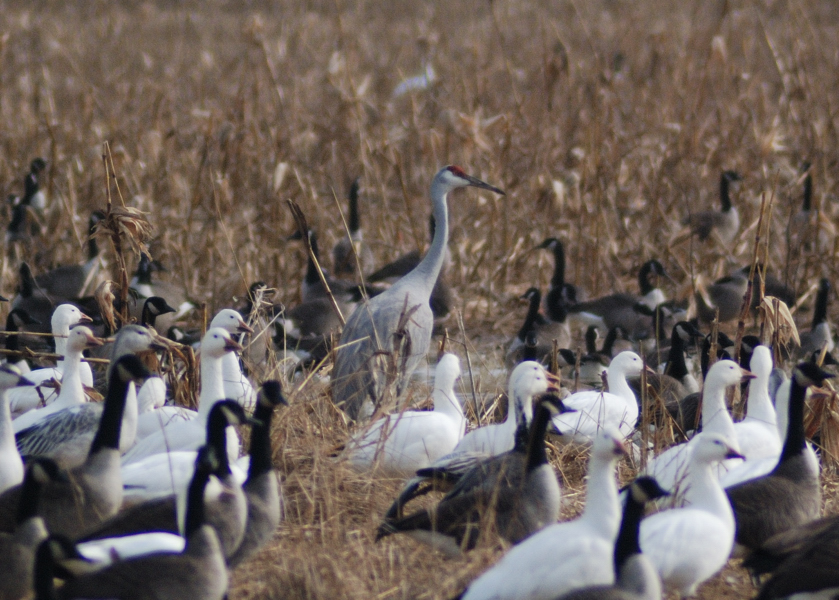
The continuing Sandhill Crane has now been present over five months!

Tuesday, November 29, 2011

Sandhill Crane and Cackling Geese at Green Pond ~ November 27, 2011

I made an afternoon stop at Green Pond and found the Sandhill Crane standing among Snow Geese.
Sandhill Crane at the flooded fields by Green Pond, Northampton County.


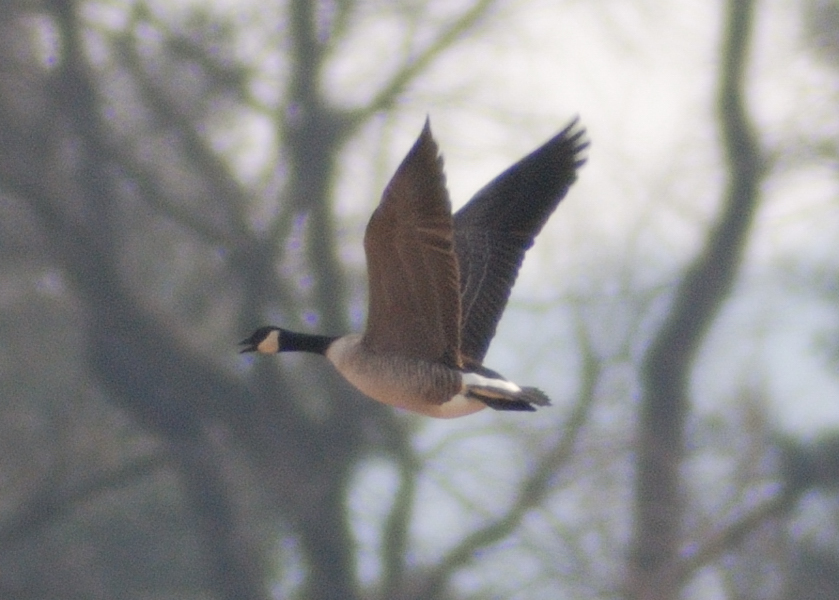
Just as I picked out a Cackling Goose among the few thousand Canadas, it flew off to the eastern edge of the cornfield.
Cackling Goose flying over the flooded fields by Green Pond, Northampton County. Note the obvious short neck.


Then, a tight group of six "Richardson's" Cackling Geese swam fairly close, providing some great comparisons between them and the surrounding Canadas.


Two "Richardson's" Cackling Geese bracketing a Canada Goose at the flooded fields by Green Pond, Northampton County. In comparison to the Canada Goose, note the Cacklings' much smaller overall size and their more silvery or grayish backs, shorter necks, stubbier bills, and more vertical foreheads, which make the heads look 'blocky'. Another trait that most Cackling Geese show is a white 'chinstrap' that often appears wider and more horizontal at its top edge.


Another Cackling Goose / Canada Goose comparison. In addition to the aforementioned points, note the hint of a white line between the dark neck and the gray breast shown by some birds.


I also found a male Green-winged Teal that had no vertical white bar but only had a hint of a horizontal stripe on the wing, bringing up the possibility of the dreaded American/Eurasian Teal 'hybrid'. I tried to get photos of it, but it was fairly concealed in among the corn stubble and blocked most of the time by Canada Geese.

Friday, November 25, 2011

Rufous Hummingbirds in Northampton County ~ November 19, 2011

I finally got a chance to get to Jacobsburg State Park on Saturday afternoon and take some photos of "Rufus", the adult male Rufous Hummingbird that originally showed up on the 11th at the park office feeder maintained by Rick Wiltraut.
Rufous Hummingbird at Jacobsburg State Park.


There's a real interesting story behind this little guy. When Rick realized that the bird was already banded, he contacted Scott Weidensaul, who came and captured it on the 14th. The number on the band revealed that it had been banded as an immature male on January 9, 2011 in River Ridge, Louisiana by famed hummingbird bander Nancy Newfield. So, he is now on his second migration and will hopefully end up back in Louisiana for the winter.

In addition to its banded history, it's interesting that this bird's wings made a whistling noise in flight like that of a Broad-tailed. You often heard it coming before it got to the feeder. Since most of the birds that show up in PA are immature birds, it was a special treat to get to see this nice adult male, only the second one I've ever seen in PA.

This has been an exceptional season for Rufous Hummingbirds. A few weeks before, the same park office feeder fed a 'Selasphorus' hummingbird that was most likely a Rufous. And just a few miles away, another Rufous Hummingbird, this one an adult female, was visiting a feeder near Delabole. In addition to these three Northampton County visitors, yet another Rufous was discovered at a feeder in Allentown near Lake Muhlenberg.

Tuesday, August 2, 2011

Gray-hooded Gull in New York ~ August 1, 2011

News of an amazing find of a Gray-hooded Gull at Coney Island in Brooklyn, New York sent Jason Horn, Matt Sabatine, and I to the spot. This gull is normally found in South America and Africa. The only U.S. record of this bird comes from Florida back in 1998.

We left Sunday afternoon and found out that the bird flew off about 15 minutes before we got there. We stayed until dark, but the bird never returned. So, we drove back over on Monday and got there just after sunrise. We watched and waited until 1:00 and the bird never showed. After spending a total of about 11 hours there over two days, we dejectedly headed back home. Then, as we were crossing the Verrazano Narrows Bridge, we found out that the bird had returned to the very spot we just left! We turned around, headed back, and finally got to see this interesting gull. If accepted, this bird will represent only the 2nd record for the United States.

Gray-hooded Gull at Coney Island Beach in Brooklyn, New York. Note the light gray hood, the pale eye, the red bill with a dark tip, and the red legs.


Gray-hooded Gull at Coney Island Beach in Brooklyn, New York. Note the light gray hood, the pale eye, the red bill with dark tip, the red legs, and all-white tail.


We had many other interesting sightings from Coney Island, but most of them were not bird-related and probably cannot be legally posted here.

Sunday, July 24, 2011

White Ibis AND Sandhill Crane at Green Pond ~ July 24, 2011

I got a mid-afternoon call from Arlene Koch telling me about a very interesting post on PABIRDS. Joe Greco and his son, Jeff, were at the flooded fields at Green Pond where Jeff had just found a juvenile White Ibis. I headed down there and found the bird very near the road in the same easternmost pond.
White Ibis at the flooded fields by Green Pond, Northampton County.


Dustin Welch was also there. Soon after Matt Sabatine and Arlene Koch showed up, the bird flew west over into the main flooded area and landed next to the Sandhill Crane, which was also there to the east of 'the island'. The heat and humidity were nasty, but getting a chance to look at both of these birds standing next to each other in Northampton County was most likely a 'once-in-a-lifetime' proposition. Devich Farbotnik and Billy Weber joined us as we watched the Sandhill Crane periodically harass the White Ibis as shown in these photos.


White Ibis being chased by a Sandhill Crane at the flooded fields by Green Pond, Northampton County.


This is the 1st record of White Ibis for Green Pond, which brings my unofficial cumulative total for the site at 161 species. To view this list and a map of the area, go to my Eastern PA Birding website and click on the 'Site Guide to Green Pond and the Flooded Fields'.
This bird also represents only the 3rd record for Northampton County.
A good number of shorebirds were also present. They included numbers of Killdeer and Least Sandpipers with some Lesser Yellowlegs and Spotted and Solitary Sandpipers mixed in.

Tuesday, May 17, 2011

Red-necked Phalarope at Green Pond ~ May 16, 2011

Even though I'm always hoping to find something good during poor migration conditions, I was happily surprised to find a Red-necked Phalarope at the flooded fields by Green Pond this afternoon. The bird spent much of its time behind 'the island'. It eventually wandered around to the left (east) side of the flooded area and got close enough to allow me to get some photos of this breeding-plumaged female despite the dreary conditions.
Red-necked Phalarope at the flooded fields by Green Pond, Northampton County.


This cooperative Spotted Sandpiper was one of several there in addition to a Lesser Yellowlegs and about a dozen Least Sandpipers.
Spotted Sandpiper at the flooded fields by Green Pond, Northampton County.


An American Black Duck and a Great Egret were also there.

To view a map of the area, go to my Eastern PA Birding website and click on the 'Site Guide to Green Pond and the Flooded Fields'.

Monday, April 25, 2011

Around Northampton County ~ April 25, 2011

After seeing Blue-headed Vireo, several Ruby-crowned Kinglets, Palm Warbler, Black-throated Green, and several Yellow-rumped Warblers outside my house on Easter morning and waking up this morning to Rose-breasted Grosbeaks on my feeders, I decided to take advantage of my day off today and take a run around the county, which happily turned out to be more than worth the amount I spent on gas.

I started out by walking the Bethlehem Boat Club area, which held Warbling Vireo, Blue-gray Gnatcatcher, Wood Thrush, several Northern Parulas, Yellow-throated Warbler, and American Redstart. An Eastern Screech-Owl stuck its head out of one of the Wood Duck boxes along the old canal.
Eastern Screech-Owl along the Lehigh Canal near the Route 33 boat launch.


A stop at Green Pond yielded Green-winged Teal, Northern Pintail, and a Great Egret at the pond itself.
Great Egret perched along the edge of Green Pond.


At Christian Springs Road in Lower Nazareth Township, I saw a Snow Goose, Green-winged and Blue-winged Teal, and a Green Heron.
Green Heron along Christian Springs Road in Lower Nazareth Township.


My next stop was Graver's Hill, where I found a Horned Lark and a couple of singing Vesper Sparrows.


Vesper Sparrow at Graver's Hill in Moore Township. The chestnut-colored shoulder patch is really obvious in the bottom two photos.


I then headed halfway up Smith Gap. In addition to Blue-gray Gnatcatcher and a few Black-and-white Warblers, I had 'fly-by's of Cooper's Hawk, Broad-winged Hawk, and a Common Raven that called as it soared by.
Common Raven over Smith Gap in Moore Township.


The Albert Road ponds, near Wind Gap, produced Ring-necked and Ruddy Duck, Pied-billed Grebe, and American Coot.

I did a real quick stop at Jacobsburg State Park at mid-day and came up with House Wren, Eastern Towhee, and Field Sparrow.

The day ended with an exclamation point when a male Ruby-throated Hummingbird popped into the feeder three feet away from where I typed this. Not a bad day!


Ruby-throated Hummingbird at my feeder in Williams Township.

Sunday, March 20, 2011

Iceland Gull Bonanza in Northampton County ~ March 19, 2011

I spent the afternoon (1:00 to 4:15) at the flooded fields by Green Pond and had a record day there. In addition to seeing the 1st-winter Iceland Gull and the 2nd-winter Iceland that were there earlier in the week, I also found two different adult Iceland Gulls. I had only seen one other adult in the county before; that was at the Chain Dam back in 2004. The first adult that I found had very dark markings on the primaries while the second adult had gray barring on the primaries.
Iceland Gull at the flooded fields by Green Pond, Northampton County. Note the charcoal gray markings on the pale primaries and the streaking on the head and neck. The mantle appears much darker here than it actually was because of the bird being backlit.


Iceland Gull at the flooded fields by Green Pond, Northampton County. Note the very limited charcoal gray markings on the pale primaries and the streaking on the head and neck.


Iceland Gull at the flooded fields by Green Pond, Northampton County. Note the light grayish markings on the pale primaries compared to the much darker markings on the previous adult. Also note the fairly clean neck compared to the fairly extensive streaking on the previous bird's neck.


Iceland Gull at the flooded fields by Green Pond, Northampton County. Again, note the light grayish markings on the pale primaries compared to the much darker markings on the previous adult. Also note the fairly clean white neck compared to the fairly extensive streaking on the previous bird's neck.


When I originally spotted the first adult, thoughts of Thayer's popped in my head but were quickly ruled out when noticing other points (not enough black in the primaries, wrong head and bill shape, and eventually getting to see the light eye). I admit that the Thayer's/Kumlien's complex still confuses the crap out of me.

The Icelands were among about 250 Lesser Black-backed Gulls (counts of 257 and 233 were taken at two different times), about 250-300 Ring-billed Gulls, and about 20 Herring Gulls. Around 3:30, most of the gulls lifted off thanks to a Red-tailed Hawk and headed east, but the adult Iceland Gull with the gray primaries was still there when I left with about 100 other gulls.

Other notables included the following:
27 Snow Geese (two with yellow bands marked "12CC" and "51CC")
4 Green-winged Teal
3 Northern Pintail
1 American Coot
2 Killdeer
2 Tree Swallows.

These two adult birds plus the continuing 1st-winter and 2nd-winter birds produced a site record four Iceland Gulls at one time!

Monday, January 17, 2011

California Trip ~ January 11, 2011

I left home at 2:30 AM, headed for the Wilkes-Barre/Scranton Airport, and caught my flight to Philadelphia. From there, I transferred to a flight to Los Angeles. In Los Angeles, I met up with Jason Horn and Devich Farbotnik and we headed for south end of the Salton Sea.

We stopped along Vendel Road and spotted the group of dark geese among the many Snow Geese. Among the eight Greater White-fronted Geese was the "Taiga/Tundra" Bean-Goose! It was a life bird for all of us. The bird never came closer than a hundred yards but was very obvious with a scope. Some Ross's Geese were in among the Snow Geese flock. Other birds seen from there were Eared Grebe, Great Egret, White-faced Ibis, Green-winged Teal, Northern Pintail, Northern Shoveler, American Wigeon, White-tailed Kite, American Avocet, Long-billed Curlew, Long-billed Dowitcher, Black and Say's Phoebe, Horned Lark, White-crowned Sparrow, and Red-winged Blackbird.

In the waning daylight, we drove to the north end of Vendel Road. From the observation deck, we watched the numbers of Sandhill Cranes and Snow Geese flying in to their roost locations.
Sandhill Cranes flying over the Salton Sea near Westmorland, California after sunset. A Northern Harrier cruises the area at the bottom of the photo.


Also seen from there were Ruddy Duck, American White Pelican, Cattle Egret, Black-necked Stilt, and Marsh Wren. At dusk, we had Sora, Virginia Rail, American Bittern, and the 'Yuma' Clapper Rail. We spent the night at the Brawley Inn.

California Trip ~ January 12, 2011

In the early morning, we found the Black-throated Green Warbler that was reported in Brawley, a rare find for southern California. We went back out to Vendel Road to see if the "Taiga/Tundra" Bean-Goose might be closer to the road. It was there, but was about the same distance away as the day before. Considering the long distance, I was happy to get a few identifiable photos of the bird.
"Taiga/Tundra" Bean-Goose along Vendel Road at the southwestern end of the Salton Sea near Westmorland, California. This bird associated with 8 Greater White-fronted Geese. The orange-yellow band near the tip of the bill is barely visible here.


"Taiga/Tundra" Bean-Goose (facing right) along Vendel Road at the southwestern end of the Salton Sea near Westmorland, California. Again, note the orange-yellow band near the tip of the bill.


At the northern end of Vendel Road, a 'Large-billed' Savannah Sparrow perched in a bush near a Black Phoebe.
Black Phoebe along Vendel Road near Westmorland, California.


The nearby roads held a number of Mountain Plovers, Long-billed Curlews, and a Ferruginous Hawk.
Ferruginous Hawk at the southern end of the Salton Sea near Westmorland, California.


We scanned the sea and the shoreline from Lack Road and found Eared and Western Grebe, Brown Pelican, Double-crested Cormorant, Snowy Plover, Willet, Western and Least Sandpiper, Dunlin, California Gull, and Caspian Tern. Other birds seen along the way included Snowy Egret, Black-crowned Night-Heron, Peregrine Falcon, Black-bellied Plover, Marbled Godwit, Stilt Sandpiper, Long-billed Dowitcher, American Pipit, Loggerhead Shrike, "Audubon's" Warbler, and Western Meadowlark.

A stop of the heaquarters of the Sonny Bono Salton Sea National Wildlife Refuge produced Gambel's Quail, Common Ground-Dove, Anna's Hummingbird, Verdin, Black-tailed Gnatcatcher, and Abert's Towhee.
Gambel's Quail at the headquarters of the Sonny Bono Salton Sea National Wildlife Refuge, California.


Common Ground-Doves at the headquarters of the Sonny Bono Salton Sea National Wildlife Refuge, California.


Anna's Hummingbird at the headquarters of the Sonny Bono Salton Sea National Wildlife Refuge, California.


At the headquarters, we found out about three Lesser Flamingos that were being seen at the north end of Garst Road. So, we took the short drive there and, sure enough, they were still there. They were several hundred yards out in the shallow water, so I took a crude photo of one of them through my scope.
Lesser Flamingo at the southeastern end of the Salton Sea, California.


A stop at Salton City on the west side of the sea yielded Surf Scoter, Merlin, Black-bellied Plover, Willet, Long-billed Dowitcher, a Laughing Gull, California Gull, and two Burrowing Owls that stood along one of the streets.
Two Burrowing Owls at Salton City, California.


We drove back to Los Angeles and slept a few hours in the car in a nearby parking lot before heading to the airport.

California Trip ~ January 13, 2011

We flew from Los Angeles to San Francisco, got our rental car and headed north across the Golden Gate Bridge and up Highway 101 toward McKinleyville. Along the way, we spotted Western Grebe, Red-shouldered Hawk, Mew, Western, and Glaucous-winged Gull, and Western Scrub-Jay.

We arrived at the Vista Point Overlook in the early afternoon and walked down the trail in light rain and drizzle towards two ponds below the bluff along the beach.
The view from the Vista Point Overlook along Highway 101 north of McKinleyville, looking southwest towards the area where the Brown Shrike was found. The shrike was seen near the left edge of this pond and another that is just out of view.


After a few minutes of searching the area between the two ponds, Devich spotted the Brown Shrike, another life bird for Devich and I. It stayed low in the bushes most of the time. Despite the dreary weather conditions, I got a mediocre photo of it.
Brown Shrike near McKinleyville, California. Note the dark mask with white border, the overall brownish color on the head and the back, and the bi-colored bill. The barred sides were present but are not visible in this photo.


Mallard, Ring-necked Duck, and Bufflehead were in the nearby pond. Along the trail were White-tailed Kite, Anna's Hummingbird, 'Red-shafted' Flicker, the coastal form of Bushtit, Marsh Wren, Ruby-crowned Kinglet, Hermit and Varied Thrush, American Robin, Wrentit, "Audubon's" Warbler, 'Sooty' Fox Sparrow, and White-crowned Sparrow. Satisfied with the looks we had at the shrike, we drove to nearby Trinidad Head. There, we saw Pelagic Cormorant, Canada Goose, California Quail, Hermit Thrush, Song Sparrow, and 'Sooty' Fox Sparrow.

We headed back south on 'the 101' and stayed at a Motel 6 in Ukiah.

California Trip ~ January 14-15, 2011

January 14, 2011

We headed west on Highway 253 towards Boonville. About seven miles from Ukiah, I pointed out a round blob in a tree on Jason's side of the car. He said, "Pygmy-Owl!" We parked and walked back to the bird, which was more interested in looking for breakfast than at us.
Northern Pygmy-Owl along Highway 253 between Ukiah and Boonville, California.


We continued west towards Point Arena. Birds seen along the way included Band-tailed Pigeon, Acorn and Lewis's Woodpecker, Steller's and Western Scrub-Jay, Oak Titmouse, White-breasted Nuthatch, Ruby-crowned Kinglet, Western Bluebird, Townsend's Warbler, Lark Sparrow, and 'Oregon' Junco. At Point Arena Cove, 'Big Al', the Laysan Albatross that's visited the cove since 1994, was floating and preening off the pier. This was another 'lifer' for me.
Laysan Albatross at Point Arena Cove, California.


Laysan Albatross at Point Arena Cove, California. Here, the bird is scratching its head.


Also found at the cove were Pelagic Cormorant, Surf Scoter, Peregrine Falcon, California Quail, Black Oystercatcher, Western and Glaucous-winged Gull, Belted Kingfisher, 'Sooty' Fox Sparrow, White-crowned and Golden-crowned Sparrow, and Western Meadowlark.

From there, we headed back to Boonville along Mountain View Road. A quick stop was made at a redwood grove to take some photos.

A redwood grove along Mountain View Road between Point Arena and Boonville, California.


From Boonville, we headed south towards the Stockton area where a Whooper Swan and "Bewick's" Swan had been reported. Along the way, we found Great, Snowy, and Cattle Egret, Bufflehead, Ruddy Duck, White-tailed Kite, Sharp-shinned and Red-shouldered Hawk, Golden Eagle, and Marbled Godwit.

We arrived at King Island, northwest of Stockton, to find about 6000 Tundra Swans in a flooded field and many more flying in and out of the area. After about an hour of searching, one "Bewick's" Swan and the Whooper Swan was picked out among the masses. Other birds seen there included Green Heron, Black-crowned Night-Heron, Wood Duck, Northern Pintail, Northern Shoveler, American Wigeon, a Eurasian Wigeon that Jason spotted, Common Goldeneye, Sandhill Crane, Greater Yellowlegs, and Barn Owl.

When it was too dark to scan anymore, we headed back to San Francisco, and stayed near the airport at the worst Motel 6 I'd ever been in.


January 15, 2011

We drove to the airport, returned the rental car, and got on a plane for Philadelphia. I switched planes, flew to Wilkes-Barre, and drove home, getting there around 11 PM. It was an extremely successful trip. I saw four 'lifers' and several subspecies that might be split in the future among the 140 species.

More photos of the trip can be found at my California Photo Album.
The trip list follows.


California Trip ~ January 11-15, 2011

1) Greater White-fronted Goose
2) "Taiga/Tundra" Bean-Goose*
3) Snow Goose
4) Ross's Goose
5) Canada Goose
6) Tundra Swan (including "Bewick's" Swan)
7) Whooper Swan*
8) Wood Duck
9) Mallard
10) Green-winged Teal
11) American Wigeon
12) Eurasian Wigeon
13) Northern Pintail
14) Northern Shoveler
15) Ring-necked Duck
16) Surf Scoter
17) Common Goldeneye
18) Bufflehead
19) Ruddy Duck
20) Wild Turkey
21) Gambel's Quail
22) California Quail
23) Eared Grebe
24) Western Grebe
25) Laysan Albatross*
26) American White Pelican
27) Brown Pelican
28) Pelagic Cormorant
29) Double-crested Cormorant
30) American Bittern
31) Black-crowned Night-Heron
32) Green Heron
33) Cattle Egret
34) Snowy Egret
35) Great Egret
36) Great Blue Heron
37) Lesser Flamingo (origin unknown)
38) White-faced Ibis
39) Turkey Vulture
40) Osprey
41) White-tailed Kite
42) Northern Harrier
43) Golden Eagle
44) Bald Eagle
45) Sharp-shinned Hawk
46) Red-shouldered Hawk
47) Red-tailed Hawk
48) Ferruginous Hawk
49) American Kestrel
50) Merlin
51) Peregrine Falcon
52) 'Yuma' Clapper Rail {yumanensis}
53) Virginia Rail
54) Sora
55) American Coot
56) Sandhill Crane
57) Black-bellied Plover
58) Snowy Plover
59) Semipalmated Plover
60) Killdeer
61) Mountain Plover
62) Black Oystercatcher
63) American Avocet
64) Black-necked Stilt
65) Willet
66) Greater Yellowlegs
67) Long-billed Curlew
68) Marbled Godwit
69) Dunlin
70) Western Sandpiper
71) Least Sandpiper
72) Long-billed Dowitcher
73) Stilt Sandpiper
74) Laughing Gull
75) Ring-billed Gull
76) Mew Gull
77) California Gull
78) Herring Gull
79) Western Gull
80) Glaucous-winged Gull
81) Caspian Tern
82) Band-tailed Pigeon
83) Rock Pigeon
84) Mourning Dove
85) Eurasian Collared-Dove
86) Common Ground-Dove
87) Barn Owl
88) Northern Pygmy Owl (Pacific coast)
89) Burrowing Owl
90) White-throated Swift
91) Anna's Hummingbird
92) Belted Kingfisher
93) Acorn Woodpecker
94) Lewis's Woodpecker
95) Gila Woodpecker
96) Northern (Red-shafted) Flicker
97) Hairy Woodpecker
98) Black Phoebe
99) Say's Phoebe
100) Brown Shrike*
101) Loggerhead Shrike
102) Steller's Jay
103) Western Scrub-Jay
104) American Crow
105) Common Raven
106) Horned Lark
107) Tree Swallow
108) Wrentit
109) Oak Titmouse
110) Verdin
111) Bushtit {minimus}
112) White-breasted Nuthatch
113) Marsh Wren
114) Ruby-crowned Kinglet
115) Black-tailed Gnatcatcher
116) Western Bluebird
117) Hermit Thrush
118) Varied Thrush
119) American Robin
120) Northern Mockingbird
121) European Starling
122) American Pipit
123) Cedar Waxwing
124) Yellow-rumped (Audubon's) Warbler
125) Townsend's Warbler
126) Black-throated Green Warbler
127) Abert's Towhee
128) Lark Sparrow
129) Fox Sparrow {fuliginosa}
130) Savannah Sparrow (including "Large-billed" Sparrow {rostratus})
131) Song Sparrow {morphna}
132) White-crowned Sparrow
133) Golden-crowned Sparrow
134) Dark-eyed (Oregon) Junco
135) Western Meadowlark
136) Red-winged Blackbird
137) Great-tailed Grackle
138) Brewer's Blackbird
139) House Finch
140) House Sparrow

* Denotes "Life Bird".