Monday, January 9, 2012

Hooded Crane at Hiwassee Wildlife Refuge, Tennessee ~ January 5-7, 2012

Devich Farbotnik and I left Thursday night and drove to the Hiwassee Wildlife Refuge in Tennessee, getting there before first light Friday morning. We spent all day Friday looking for the Hooded Crane that had been seen there since mid-December among about 10,000 Sandhill Cranes, but it never came into view.
Sandhill Cranes at the Hiwassee Wildlife Refuge.


Despite not seeing the Hooded Crane all day Friday, we did see a young Whooping Crane.
A long-distance photo of a Whooping Crane at the Hiwassee Wildlife Refuge. Note the rusty coloration on the head and neck and some near the rump.


Several Bald Eagles were present most of the day, occasionally stirring up the cranes as they flew overhead. A cooperative Eastern Phoebe flew around the viewing platform.
Eastern Phoebe at the Hiwassee Wildlife Refuge.


We stayed overnight in nearby Cleveland and returned Saturday morning. At around 8:45, the Hooded Crane flew in and landed in a field. It was only in view for about five minutes when a Sandhill Crane chased it behind some trees, so I wasn't able to get a documentation photo of it, but Devich was able to get an identifiable photo of it with his phone through his scope.
Devich Farbotnik's photo of the Hooded Crane (center, facing left) at the Hiwassee Wildlife Refuge. Note the dark forehead and light bill on the white head and the charcoal-colored body.


We left around noon and got back home around 11:00 Saturday night. The trip encompassed 1537 miles.

Wednesday, January 4, 2012

Common Chaffinch in Hunterdon County, New Jersey ~ January 3, 2012

Just three days into the new year, I got news of a potential 'lifer' less than thirty minutes from my house! So I headed across the Delaware River to Hunterdon County, New Jersey where, after about a half-hour wait, I got to see a male Common Chaffinch that was visiting a private feeder.

Common Chaffinch in Hunterdon County, New Jersey.


The bird's plumage looked pristine and there were no leg bands of any kind. If this bird is accepted by the New Jersey records committee, it would be my 750th ABA bird!

Sunday, January 1, 2012

Bethlehem - Easton - Hellertown CBC ~ December 31, 2011

Andy Cuttic, Stephen Kloiber, and I were at the Nazareth Quarry at first light to try and get a fairly accurate count of the Snow Geese before they started heading out to feed in the nearby fields. We conservatively estimated 20,000 birds stretching across the entire quarry.
Many of the Snow Geese rising out of the Nazareth Quarry, Northampton County and heading to their preferred feeding areas.


Among the mass of white, we found 4 Cackling Geese, a Hooded Merganser, 3 Pied-billed Grebes, a Horned Grebe, and a 1st-winter Iceland Gull in addition to 14 American Black Ducks, 19 Ring-necked Ducks, 14 Buffleheads, 21 Common Mergansers, 16 Ruddy Ducks, 3 Great Blue Herons, 2 Black Vultures, 8 American Coots, 9 Herring Gulls, and a nice count of 56 Lesser Black-backed Gulls.

The surrounding ponds and woods produced a Sharp-shinned Hawk, a Belted Kingfisher, a Yellow-bellied Sapsucker, a Winter Wren, a Golden-crowned Kinglet, 18 Eastern Bluebirds, 15 American Robins, a Yellow-rumped Warbler, an American Tree Sparrow, and a Swamp Sparrow.

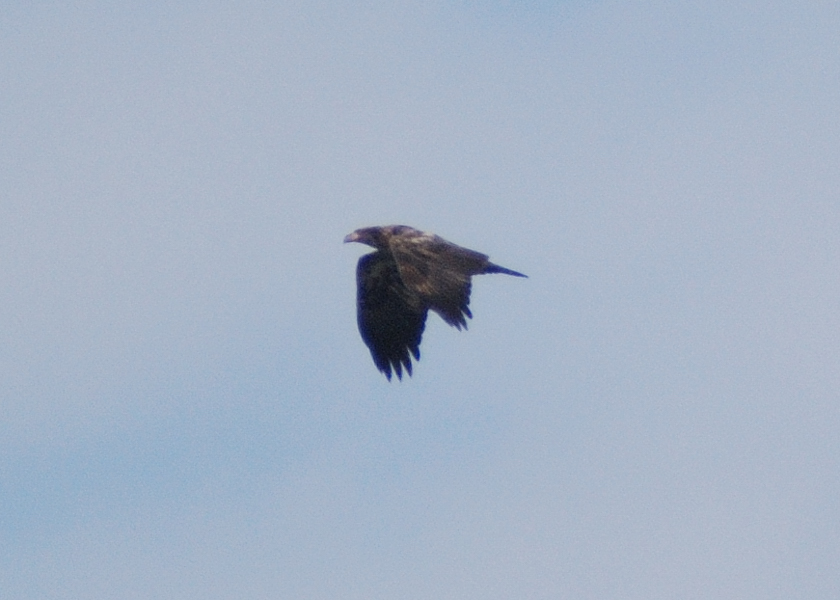
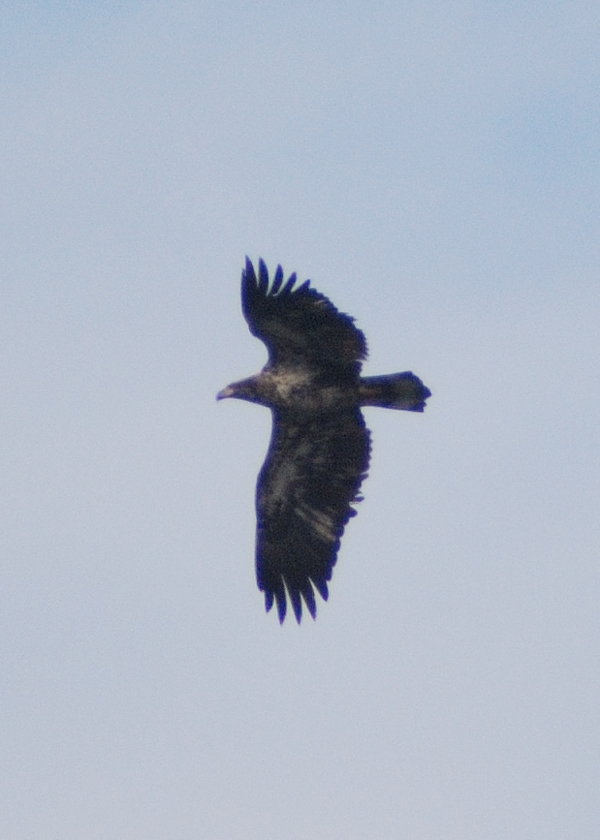
While checking the quarry out once more before leaving there, an immature Bald Eagle came soaring in from the east.

An immature Bald Eagle over the Nazareth Quarry, Northampton County.


As the eagle approached, a thunderous sound erupted as the Snows launched into the air.
Thousands of Snow Geese at the Nazareth Quarry, Northampton County.


A stop at the flooded fields by Green Pond produced a female Wood Duck, two Green-winged Teal, and this unexpected Northern Shoveler.
A Northern Shoveler at the flooded fields by Green Pond, Northampton County.


After a fairly quiet afternoon along the Lehigh River, we headed back up towards Nazareth and spotted a nice adult Peregrine Falcon that landed on one of the high-tension towers near the Hecktown Road exit of Route 33. We ended the day with 57 species!

Tuesday, December 20, 2011

Cackling Geese at Green Pond ~ December 18, 2011

I stopped at Green Pond after doing the Wild Creek / Little Gap Christmas Bird Count and found a few Cackling Geese among about about a thousand Canadas and about 1500 Snow Geese.
A "Richardson's" Cackling Goose with a Canada Goose at the flooded fields by Green Pond, Northampton County. In comparison to the Canada Goose, note the Cackling's much smaller overall size and its more silvery or grayish appearance, shorter neck, stubbier bill, and more vertical forehead, which makes the head look 'blocky'. Another trait that most Cackling Geese show is a white 'chinstrap' that often appears wider and more horizontal at its top edge.

The continuing Sandhill Crane has now been present over five months!

Tuesday, November 29, 2011

Sandhill Crane and Cackling Geese at Green Pond ~ November 27, 2011

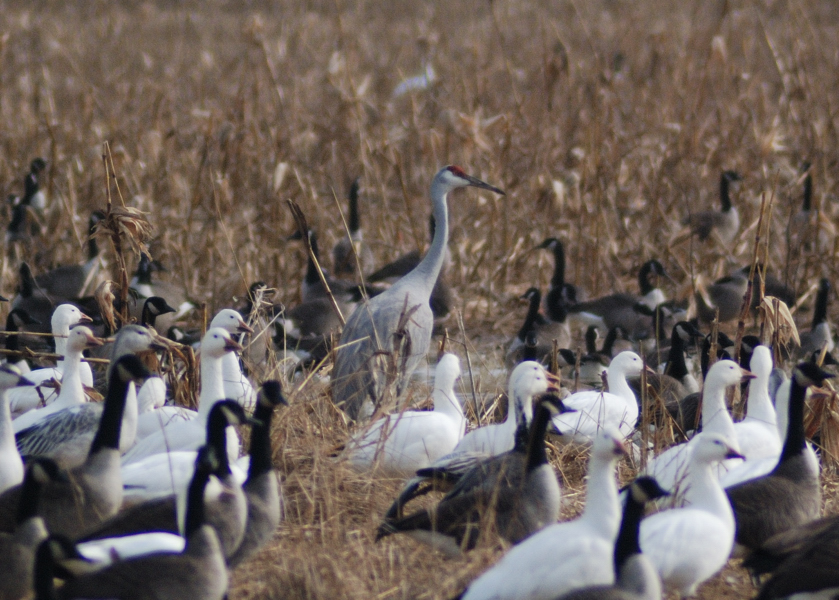
I made an afternoon stop at Green Pond and found the Sandhill Crane standing among Snow Geese.
Sandhill Crane at the flooded fields by Green Pond, Northampton County.


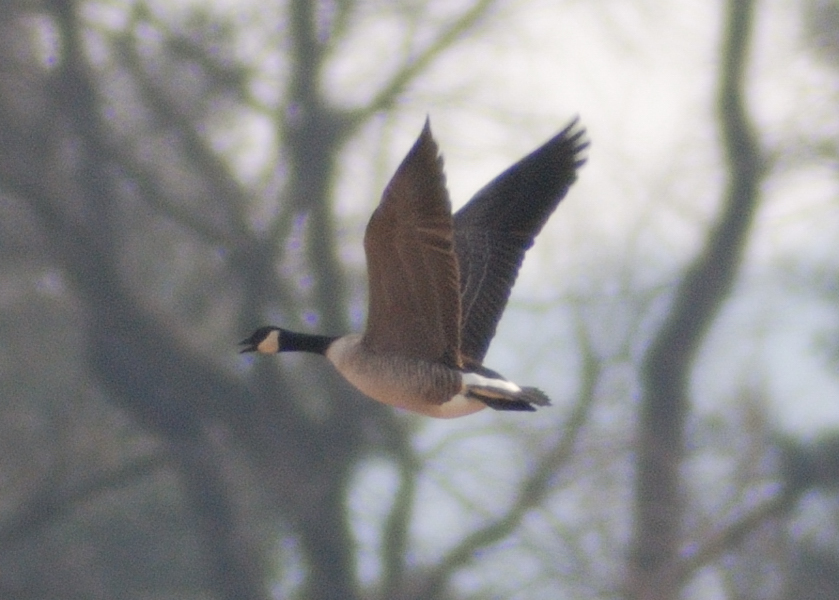
Just as I picked out a Cackling Goose among the few thousand Canadas, it flew off to the eastern edge of the cornfield.
Cackling Goose flying over the flooded fields by Green Pond, Northampton County. Note the obvious short neck.


Then, a tight group of six "Richardson's" Cackling Geese swam fairly close, providing some great comparisons between them and the surrounding Canadas.


Two "Richardson's" Cackling Geese bracketing a Canada Goose at the flooded fields by Green Pond, Northampton County. In comparison to the Canada Goose, note the Cacklings' much smaller overall size and their more silvery or grayish backs, shorter necks, stubbier bills, and more vertical foreheads, which make the heads look 'blocky'. Another trait that most Cackling Geese show is a white 'chinstrap' that often appears wider and more horizontal at its top edge.


Another Cackling Goose / Canada Goose comparison. In addition to the aforementioned points, note the hint of a white line between the dark neck and the gray breast shown by some birds.


I also found a male Green-winged Teal that had no vertical white bar but only had a hint of a horizontal stripe on the wing, bringing up the possibility of the dreaded American/Eurasian Teal 'hybrid'. I tried to get photos of it, but it was fairly concealed in among the corn stubble and blocked most of the time by Canada Geese.

Friday, November 25, 2011

Rufous Hummingbirds in Northampton County ~ November 19, 2011

I finally got a chance to get to Jacobsburg State Park on Saturday afternoon and take some photos of "Rufus", the adult male Rufous Hummingbird that originally showed up on the 11th at the park office feeder maintained by Rick Wiltraut.
Rufous Hummingbird at Jacobsburg State Park.


There's a real interesting story behind this little guy. When Rick realized that the bird was already banded, he contacted Scott Weidensaul, who came and captured it on the 14th. The number on the band revealed that it had been banded as an immature male on January 9, 2011 in River Ridge, Louisiana by famed hummingbird bander Nancy Newfield. So, he is now on his second migration and will hopefully end up back in Louisiana for the winter.

In addition to its banded history, it's interesting that this bird's wings made a whistling noise in flight like that of a Broad-tailed. You often heard it coming before it got to the feeder. Since most of the birds that show up in PA are immature birds, it was a special treat to get to see this nice adult male, only the second one I've ever seen in PA.

This has been an exceptional season for Rufous Hummingbirds. A few weeks before, the same park office feeder fed a 'Selasphorus' hummingbird that was most likely a Rufous. And just a few miles away, another Rufous Hummingbird, this one an adult female, was visiting a feeder near Delabole. In addition to these three Northampton County visitors, yet another Rufous was discovered at a feeder in Allentown near Lake Muhlenberg.

Tuesday, August 2, 2011

Gray-hooded Gull in New York ~ August 1, 2011

News of an amazing find of a Gray-hooded Gull at Coney Island in Brooklyn, New York sent Jason Horn, Matt Sabatine, and I to the spot. This gull is normally found in South America and Africa. The only U.S. record of this bird comes from Florida back in 1998.

We left Sunday afternoon and found out that the bird flew off about 15 minutes before we got there. We stayed until dark, but the bird never returned. So, we drove back over on Monday and got there just after sunrise. We watched and waited until 1:00 and the bird never showed. After spending a total of about 11 hours there over two days, we dejectedly headed back home. Then, as we were crossing the Verrazano Narrows Bridge, we found out that the bird had returned to the very spot we just left! We turned around, headed back, and finally got to see this interesting gull. If accepted, this bird will represent only the 2nd record for the United States.

Gray-hooded Gull at Coney Island Beach in Brooklyn, New York. Note the light gray hood, the pale eye, the red bill with a dark tip, and the red legs.


Gray-hooded Gull at Coney Island Beach in Brooklyn, New York. Note the light gray hood, the pale eye, the red bill with dark tip, the red legs, and all-white tail.


We had many other interesting sightings from Coney Island, but most of them were not bird-related and probably cannot be legally posted here.