Thanks to Tom, I got to see another new state bird.
Thursday, May 26, 2005
Seaside Sparrow in PA! ~ May 25, 2005
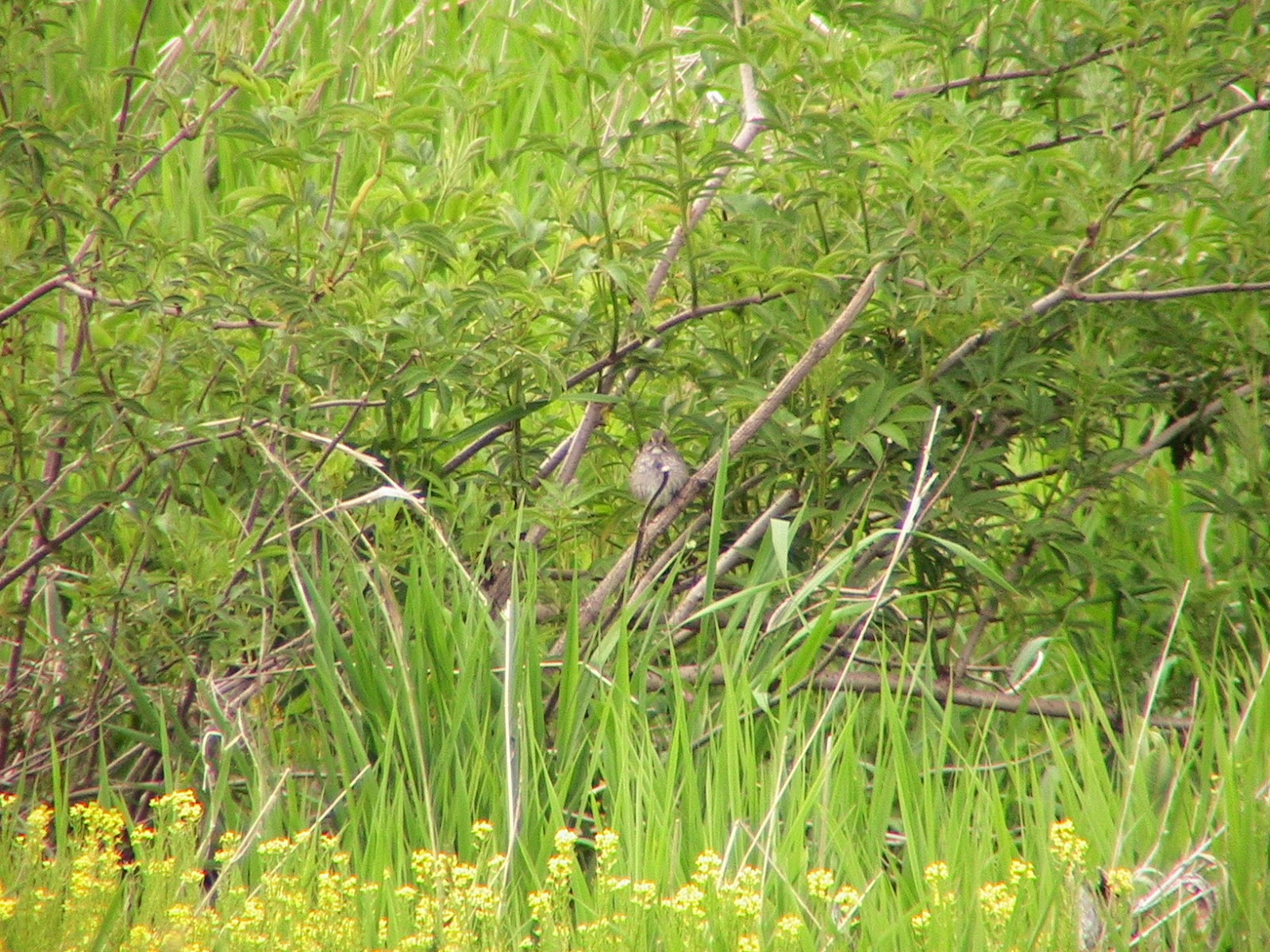
While surveying for the Pennsylvania Breeding Bird Atlas, Tom Johnson discovered a Seaside Sparrow in southern Dauphin County. Several of us waited until near sunset when the bird finally began singing from a bush for about a half-hour. I took two identifiable 'stills' with my camcorder in the failing light.
Seaside Sparrow near Deodate, Dauphin County. This bird was seen in a wet hayfield along Kennedy Road. Note the yellowish lores, dark whisker stripes, and white throat patch contrasting with the grayish breast. It represents one of only several records for Pennsylvania.
Seaside Sparrow near Deodate, Dauphin County. It represents one of only several records for Pennsylvania.
Thanks to Tom, I got to see another new state bird.
Monday, April 11, 2005
Ross's Goose at Green Pond! ~ April 10, 2005
I went over to the flooded fields by Green Pond to look for the Ross's Goose that Billy Weber found on the 8th. It was still there among about 40 Snow Geese.
Ross's Goose at the flooded fields by Green Pond in Northampton County. Note the smaller size and stubby, triangular bill compared to the surrounding Snow Geese.
Monday, March 14, 2005
Laughing Gull in Northampton County! ~ March 13, 2005
Mike Schall was down at the 'Forks of the Delaware' in Easton on the 12th and found a Laughing Gull. The bird was still there when I arrived and posed for photos.
Laughing Gull at the 'Forks of the Delaware' in Easton, Northampton County. This photo shows the dusky head, the white arcs around the eye, and the dark bill, legs, and wingtips. This bird was found a month earlier than the previous 'early date' for the area. A coastal gull, it is rarely found in our area, usually only occurring after storms with easterly winds.
Laughing Gull at the 'Forks of the Delaware' in Easton, Northampton County. This photo shows the dark gray back, the grayish-brown upperwings with darker trailing edge, and the wide, dark band across the tail.
Mike's find provided me with a new county bird.
Sunday, February 6, 2005
REDWING in PA! ~ February 5, 2005
No, not Red-winged Blackbird; a Redwing! Turdus iliacus!
August Mirabella was birding with a fairly new birder, Jessica Huff, at Peace Valley Park in Bucks County when she pointed out a bird that looked different from the group of American Robins that it was with. August called Devich Farbotnik, who helped confirm the bird's identification. Word was spread. I picked up Arlene Koch and we called a few other people along the way. Although the bird was originally found in a field, when we got there it was in an adjacent backyard, just east of the park property. It tossed leaves around in the open patches of grass in the yard with the Robins. After flying up to the top of one of the trees at the back edge of the yard, it dropped down into a more brushy area. Eventually, it was relocated in the brush along the edge of the field. I struggled to get a few barely-identifiable photos of it.
Redwing at Peace Valley Park, Bucks County. This distant 'videograb' shows the whitish eyebrow on the head, the heavily-streaked breast, and the rusty flank patch. This 1st Pennsylvania record was also only the 3rd record for the United States!
Redwing at Peace Valley Park, Bucks County. This distant, blurry 'videograb' was included because it shows the bird with its wings extended. Note the rusty wing linings located between the two vertical vines. The whitish eyebrow can be seen on the head of the bird, which is just to the left of the left vertical vine. This 1st Pennsylvania record was also only the 3rd record for the United States!
It was a shock to see an extremely rare record within an hour from home. As if the sighting wasn't amazing enough, it was also my 700th ABA Area bird!
August Mirabella was birding with a fairly new birder, Jessica Huff, at Peace Valley Park in Bucks County when she pointed out a bird that looked different from the group of American Robins that it was with. August called Devich Farbotnik, who helped confirm the bird's identification. Word was spread. I picked up Arlene Koch and we called a few other people along the way. Although the bird was originally found in a field, when we got there it was in an adjacent backyard, just east of the park property. It tossed leaves around in the open patches of grass in the yard with the Robins. After flying up to the top of one of the trees at the back edge of the yard, it dropped down into a more brushy area. Eventually, it was relocated in the brush along the edge of the field. I struggled to get a few barely-identifiable photos of it.
It was a shock to see an extremely rare record within an hour from home. As if the sighting wasn't amazing enough, it was also my 700th ABA Area bird!
Tuesday, January 18, 2005
South Texas Trip ~ January 12, 2005
On January 12th, 2005 my long-time birding friend, Babe Webster and I flew to south Texas for five days of birding to hopefully get a chance to see the numerous Mexican strays that were being reported in the area.
After getting our car in San Antonio and not being able to find the Masked Duck at a pond in Ingleside (it had not been seen for several weeks but was still worth a try), we headed on down to the Lower Rio Grande Valley.
South Texas Trip ~ January 13, 2005
On the 13th, we visited the Fontera Audubon Sanctuary in Weslaco where we saw the White-throated Robin, several Clay-colored Robins, one of the male Crimson-collared Grosbeaks, and a pair of Tropical Parulas that was with a small group of warblers.
White-throated Robin at Frontera Audubon Sanctuary in Weslaco, Texas. The bird was walking away from me in the dark understory, so you can just barely make out the dark upperparts, light undersides, and the eye ring.
Crimson-collared Grosbeak at Frontera Audubon Sanctuary in Weslaco, Texas. Note the crimson collar and breast on the otherwise all-black plumage. This male was eating the buds on the trees in the native thicket area.
Next, we headed for Bentsen State Park to look for the Social Flycatcher despite the high winds that were there.
Green Jay at Bentsen-Rio Grande State Park, Texas. Note the blue head with black markings, green back, yellow-green breast, and blue-green tail. The colors of the Green Jay have to be seen in person to be appreciated. This bird was photographed at (where else?) the Green Jay blind.
Altamira Oriole at Bentsen-Rio Grande State Park, Texas. Note the orange head, black throat, and orange 'shoulder patch'. Surprisingly, the smaller orioles were actually driving the larger Green Jays away from the feeder. This bird was photographed at the Green Jay blind.
After searching for a few hours with no luck, we headed to the Los Ebanos Preserve near Russelltown for the Golden-crowned Warbler. Luckily, a few other birders were watching it when we got there. The bird came to within three feet of us at one point!
Next, we headed for Bentsen State Park to look for the Social Flycatcher despite the high winds that were there.
After searching for a few hours with no luck, we headed to the Los Ebanos Preserve near Russelltown for the Golden-crowned Warbler. Luckily, a few other birders were watching it when we got there. The bird came to within three feet of us at one point!
South Texas Trip ~ January 14, 2005
On the very cold morning of the 14th, we went back to Bentsen at dawn and joined the other birders at Kingfisher Overlook looking for the Social Flycatcher. Over two hours later, I noticed a lemon-breasted bird come out of the brush between the bird blind and the boat ramp. Expecting it to be just another Kiskadee, I realized that the back and wings were dull green, not reddish brown. Then, the bird turned its head and I realized that it had a tiny bill---it was the Social Flycatcher! After pointing it out to Babe, I notified the rest of the surrounding birders. We all got excellent looks at it as it sunned itself before flying off towards the old trailer loop. As it turned out, that was the last day that it was seen.
Social Flycatcher at Bentsen-Rio Grande State Park, Texas. Note the dull green wings and back and small bill compared to the Great Kiskadee's below. This bird represents only the 2nd record for the United States!
Next, we headed to a McAllen backyard where we saw the Green-breasted Mango that was there among several Buff-bellied Hummingbirds.
Green-breasted Mango at a backyard in McAllen, Texas. Note the male's green color, white flanks, curved bill, and red-violet tail. This male was visiting the feeders at 500 Rose Ellen Boulevard. It vigorously defended 'its' feeder from several Buff-bellied Hummingbirds.
Buff-bellied Hummingbird at a backyard in McAllen, Texas. Note the bright green head, chestnut tail, and red bill with a black tip. The buff-colored belly is barely visible. This bird was one of several that were visiting the feeders at 500 Rose Ellen Boulevard.
It was there that a birder told us that the Blue Mockingbird had just been seen at Allen Williams' residence in nearby Pharr. We went there and although we didn't see this skulker, we did find a female Crimson-collared Grosbeak and an Olive Sparrow among the expected birds.
Great Kiskadee in Pharr, Texas. Note the black and white stripes on the head, the lemon yellow belly, and the rufous wings and tail. Also note the longer, thicker bill compared to the Social Flycatcher above. This bird was photographed in a Pharr resident's backyard.
Olive Sparrow in Pharr, Texas. Note the brown stripes on the head, the olive green wings and tail, and the unmarked gray breast. Also note the thin black line through the eye, which is bordered by white crescents. This bird was photographed in a Pharr resident's backyard.
From there, we headed up the valley and stopped at Salineno in the late afternoon. Although we didn't see Muscovy Duck, we did see Green Kingfisher and six Brown Jays.
Brown Jay at Salineno, Texas. Note the yellow bill, which designates this as a young bird. This was one of six Brown Jays that were there in addition to 3 Great Horned Owls, and Belted and Green Kingfisher. This bird was photographed near the boat ramp at the Rio Grande River.
Next, we headed to a McAllen backyard where we saw the Green-breasted Mango that was there among several Buff-bellied Hummingbirds.
It was there that a birder told us that the Blue Mockingbird had just been seen at Allen Williams' residence in nearby Pharr. We went there and although we didn't see this skulker, we did find a female Crimson-collared Grosbeak and an Olive Sparrow among the expected birds.
From there, we headed up the valley and stopped at Salineno in the late afternoon. Although we didn't see Muscovy Duck, we did see Green Kingfisher and six Brown Jays.
Subscribe to:
Posts (Atom)


