My afternoon stop at the flooded fields by Green Pond yielded a Glossy Ibis. Unfortunately, I didn't have my camera with me to document it. Luckily, some others birder got to see it later in the day.
Friday, April 20, 2007

Monday, April 9, 2007
Lazuli Bunting in PA! ~ April 8, 2007
George Franchois found a Lazuli Bunting near the town of Red Hill in Montgomery County back on March 4th. I finally managed to get a fairly good photo of it on April 8th.

Lazuli Bunting near Red Hill, Montgomery County. Note the light wingbars, buffy breast, and turquoise blue head, wings, and tail. This bird represents the first record for Montgomery County and only the third record for Pennsylvania!

Thursday, February 22, 2007
Scott's Oriole in PA! ~ February 21, 2007
I headed for the Mechanicsburg area in Cumberland County where a Scott's Oriole, a new state bird, was being seen. I was happy to get to see it and get a photo of it at a backyard feeder.
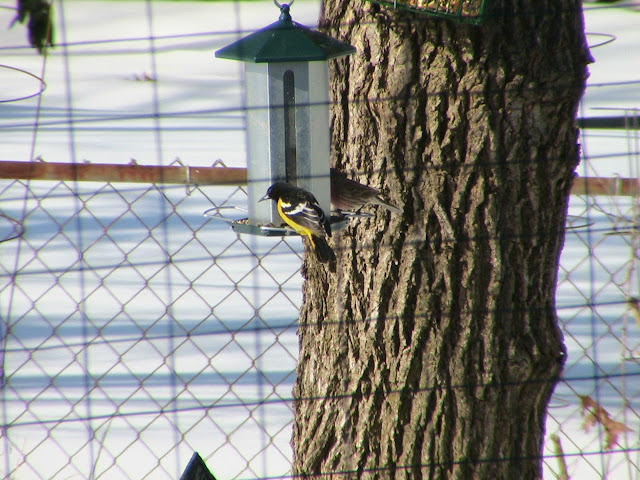
Scott's Oriole near Mechanicsburg, Cumberland County on February 21, 2007. This adult male was originally seen visiting a feeder on Kent Drive on February 19th. Note the black hood and back, lemon yellow underparts, bold white wingbars, and yellowish edges on the black tail. This bird represents the 1st record for Pennsylvania and also the only one for the entire northeastern U.S.!

Thursday, August 24, 2006
Baird's Sandpipers at Green Pond ~ August 23, 2006
During my afternoon stop at the flooded fields by Green Pond, I was pleasantly surprised to find two Baird's Sandpipers feeding in the shallow water. To my knowledge, these two birds represent the 1st records for Northampton County!


Baird's Sandpipers at the flooded fields by Green Pond, Northampton County. These photos were taken on August 24th.
A good number of Great Egrets also lined the flooded area.


A good number of Great Egrets also lined the flooded area.

Monday, June 5, 2006
Fork-tailed Flycatcher AND Black-bellied Whistling-Ducks in PA! ~ June 4, 2006
With my Pennsylvania Life List in the 360's, seeing a new state bird gets really tough anymore. So, I was totally blown away when I came home with TWO state birds in ONE day!
In late morning, I heard about four Black-bellied Whistling-Ducks that had been found in Bucks County by Rudy Keller. Since I had previously missed seeing the ones found in Westmoreland and Lancaster Counties in 1993, I was ready to head down there to look for them. But soon after that, I got another call about a probable Fork-tailed Flycatcher that was found near Morrisville in Bucks County by Bill Keim!
Billy Weber just happened to be birding at Arlene Koch's house when I got the call, so he and Arlene hopped in the car and the three of us headed down there while the bird's identification was changing from Fork-tailed to Scissor-tailed and eventually back again. When we got there, we saw that the bird had a much shorter tail than what is shown in most of the guides and, at first glance, could have possibly been passed over as an Eastern Kingbird by an inexperienced observer. This was a great find, especially since the bird was found in unusual habitat, trees right along the Delaware River.

Fork-tailed Flycatcher in Morrisville, Bucks County. Note the bird's dark cap, gray mantle, all-white underparts, and fairly long tail, which is much shorter than what is portrayed in most of the field guides because it is not an adult bird. This bird represents the first record for Pennsylvania!

Fork-tailed Flycatcher in Morrisville, Bucks County. Note the bird's dark cap, gray mantle, and fairly long tail. Here, the shaft of the tail feather on the right side can be seen protruding longer than that on the left. This bird represents the first record for Pennsylvania!
After watching and photographing the flycatcher for about an hour or more, we left and headed for the pond where Rudy Keller had seen the Black-bellied Whistling-Ducks in the late morning. We arrived at the pond, just west of the town of Pleasantville, in the early evening and found Harold Lebo and Drew Weber there. The only ducks on the pond were a pair of Mallards, but Arlene said that Rudy told her that they had been hiding in the surrounding vegetation when they weren't in the pond. So, after about 20 minutes of checking every spot we could from the road, Harold went over to the farmhouse and asked the lady there if we could walk out the path to check the near side of the pond. She kindly gave us permission and also told him that she had noticed them there a few days before. We walked out the path and there, in the near right corner of the pond (when looking from the road), were the Whistling-Ducks in just high enough vegetation that they could not be seen at all from the road. We watched them, took photos, and left them right where they were with about an hour of daylight left.


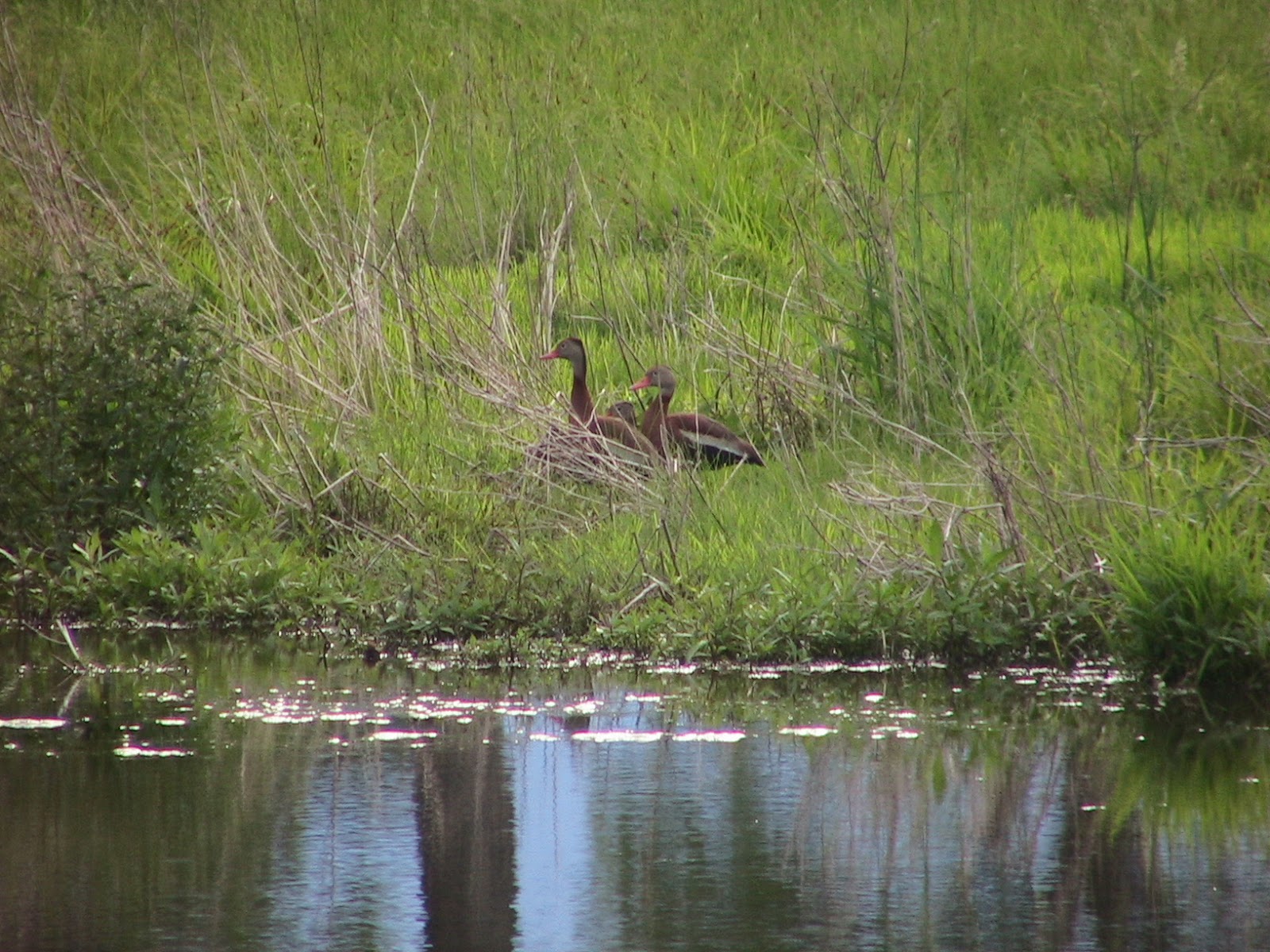
Black-bellied Whistling-Ducks near Pleasantville, Berks County. Note the black belly, white wing patch, red bill, and light eye ring on the gray face. All four birds are in this picture, although the fourth bird is hidden by the dead gray stems just below and in front of the tallest bird. There are very few records of them for Pennsylvania.
To say the least, I was thrilled with getting two state birds (and great-looking ones at that) in just several hours!
In late morning, I heard about four Black-bellied Whistling-Ducks that had been found in Bucks County by Rudy Keller. Since I had previously missed seeing the ones found in Westmoreland and Lancaster Counties in 1993, I was ready to head down there to look for them. But soon after that, I got another call about a probable Fork-tailed Flycatcher that was found near Morrisville in Bucks County by Bill Keim!
Billy Weber just happened to be birding at Arlene Koch's house when I got the call, so he and Arlene hopped in the car and the three of us headed down there while the bird's identification was changing from Fork-tailed to Scissor-tailed and eventually back again. When we got there, we saw that the bird had a much shorter tail than what is shown in most of the guides and, at first glance, could have possibly been passed over as an Eastern Kingbird by an inexperienced observer. This was a great find, especially since the bird was found in unusual habitat, trees right along the Delaware River.


After watching and photographing the flycatcher for about an hour or more, we left and headed for the pond where Rudy Keller had seen the Black-bellied Whistling-Ducks in the late morning. We arrived at the pond, just west of the town of Pleasantville, in the early evening and found Harold Lebo and Drew Weber there. The only ducks on the pond were a pair of Mallards, but Arlene said that Rudy told her that they had been hiding in the surrounding vegetation when they weren't in the pond. So, after about 20 minutes of checking every spot we could from the road, Harold went over to the farmhouse and asked the lady there if we could walk out the path to check the near side of the pond. She kindly gave us permission and also told him that she had noticed them there a few days before. We walked out the path and there, in the near right corner of the pond (when looking from the road), were the Whistling-Ducks in just high enough vegetation that they could not be seen at all from the road. We watched them, took photos, and left them right where they were with about an hour of daylight left.

To say the least, I was thrilled with getting two state birds (and great-looking ones at that) in just several hours!
Tuesday, May 23, 2006
Cancun, Mexico Trip ~ May 19, 2006
My wife and I spent May 19th to the 22nd in Cancun, Mexico to attend my stepdaughter's wedding, so this was obviously not a birding trip, but I was still able to get out and see some nice birds.
On Friday, May 19th, we flew non-stop from Philadelphia to Cancun. A shuttle took us to the Moon Palace Resort on the Riviera Maya, just south of Cancun. Without a rental car, my birding was restricted to the resort and its adjacent golf course. The damage to the vegetation done by Hurricane Wilma was still very evident. After settling in, I saw my first of five 'life' birds for the trip, a Melodious Blackbird.

Melodious Blackbird at the Moon Palace Resort near Cancun, Mexico.
This photo shows the overall glossy black coloration, the dark eyes, and the dark, pointed bill. This bird was photographed in grass next to a brushy swamp along the edge of the resort area. These birds were fairly common in the brush around the resort.
Another bird that was evident in the brushy swamps surrounding the resort was the Anhinga.

Anhinga at the Moon Palace Resort near Cancun, Mexico.
This photo shows the fairly long, sharply-pointed bill, the white on the wings and back, and the light area at the tip of the tail. This bird was photographed while drying its wings over a brushy swamp along the edge of the resort area.
Great-tailed Grackles were everywhere. Another bird that was commonly seen around the resort and its edges was the Tropical Mockingbird, which was another 'lifer' for me.

Tropical Mockingbird at the Moon Palace Resort near Cancun, Mexico.
This bird has darker wings and a much smaller area of white in the tail when compared to our Northern Mockingbird and lacks the Northern's large white wing patches in flight. This bird was photographed on a post outside our room.
On Friday, May 19th, we flew non-stop from Philadelphia to Cancun. A shuttle took us to the Moon Palace Resort on the Riviera Maya, just south of Cancun. Without a rental car, my birding was restricted to the resort and its adjacent golf course. The damage to the vegetation done by Hurricane Wilma was still very evident. After settling in, I saw my first of five 'life' birds for the trip, a Melodious Blackbird.

This photo shows the overall glossy black coloration, the dark eyes, and the dark, pointed bill. This bird was photographed in grass next to a brushy swamp along the edge of the resort area. These birds were fairly common in the brush around the resort.
Another bird that was evident in the brushy swamps surrounding the resort was the Anhinga.
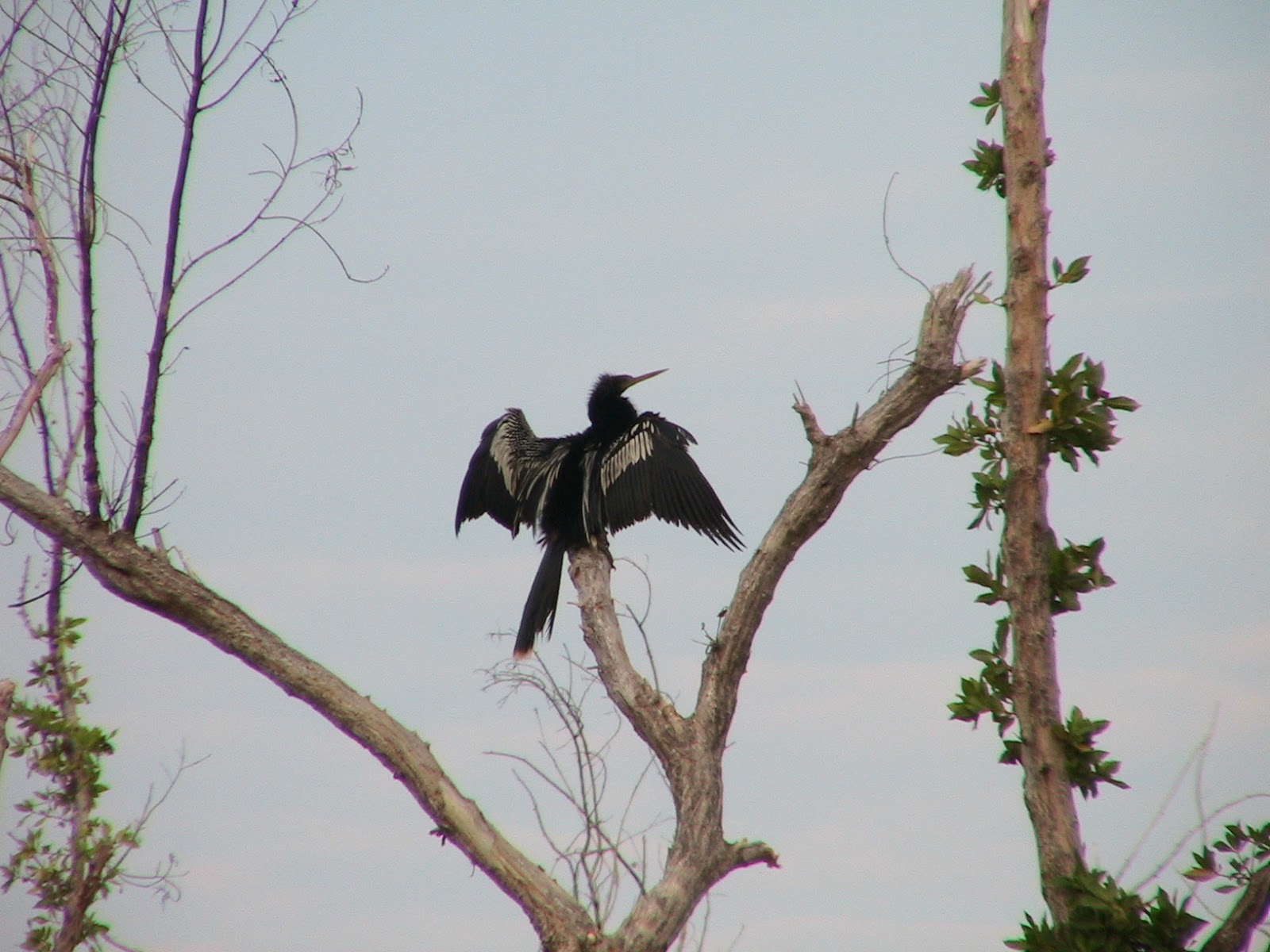
This photo shows the fairly long, sharply-pointed bill, the white on the wings and back, and the light area at the tip of the tail. This bird was photographed while drying its wings over a brushy swamp along the edge of the resort area.
Great-tailed Grackles were everywhere. Another bird that was commonly seen around the resort and its edges was the Tropical Mockingbird, which was another 'lifer' for me.

This bird has darker wings and a much smaller area of white in the tail when compared to our Northern Mockingbird and lacks the Northern's large white wing patches in flight. This bird was photographed on a post outside our room.
Cancun, Mexico Trip ~ May 20, 2006
On the morning of the 20th, I walked the golf course and found another 'lifer', a very cooperative Northern Jacana.

Northern Jacana at the Moon Palace Golf Club near Cancun, Mexico.
This photo shows the black face with the contrasting yellow forehead patch and yellow bill, black neck and breast, chestnut back and body, grayish legs and very long toes, and pale yellow flight feathers with dusky edges. This bird was photographed near one of the water hazards.

Northern Jacana at the Moon Palace Resort near Cancun, Mexico.
This photo shows how strikingly different the immature looks from the adult. Note the white underparts and face, brown cap on the head, brown back, grayish-green legs, and duller yellow bill with a dusky tip. This is one of two immature birds that were seen in a brushy swamp along the edge of the resort area.

Magnificent Frigatebird at the Moon Palace Resort near Cancun, Mexico.
This photo shows the dark head, the long, dark, pointed wings, the white chest patch, and the long, forked tail. This adult female was photographed while circling over the beach.
The rest of the day was spent at my stepdaughter's wedding and the reception.

This photo shows the black face with the contrasting yellow forehead patch and yellow bill, black neck and breast, chestnut back and body, grayish legs and very long toes, and pale yellow flight feathers with dusky edges. This bird was photographed near one of the water hazards.

This photo shows how strikingly different the immature looks from the adult. Note the white underparts and face, brown cap on the head, brown back, grayish-green legs, and duller yellow bill with a dusky tip. This is one of two immature birds that were seen in a brushy swamp along the edge of the resort area.

This photo shows the dark head, the long, dark, pointed wings, the white chest patch, and the long, forked tail. This adult female was photographed while circling over the beach.
The rest of the day was spent at my stepdaughter's wedding and the reception.
Subscribe to:
Posts (Atom)