I left the motel at 4:00 AM and made the 4-hour drive to the Bahia Beach Nature Preserve near the town of Ruskin. I was the only one there when I arrived around 8:00 AM. A strong cold front had moved through the night before. It was 41 degrees with a 10-20 mph wind. I was very glad that I had my coat and gloves with me. Lots of Yellow-rumped and Palm Warblers were low in the grasses chipping while searching for insects. I searched the area where the flycatcher was most often seen and kept coming up empty. One lady showed up, spent an hour looking, and then left.
I walked out along both the west and east sides of the impoundment, which held a bunch of birds. Four Caspian Terns were flying over the water.
American White Pelicans were present along with Great Egrets and White Ibis.
Tricolored Herons, Little Blue Herons, and Snowy Egrets fed in the pond along with American Coots.
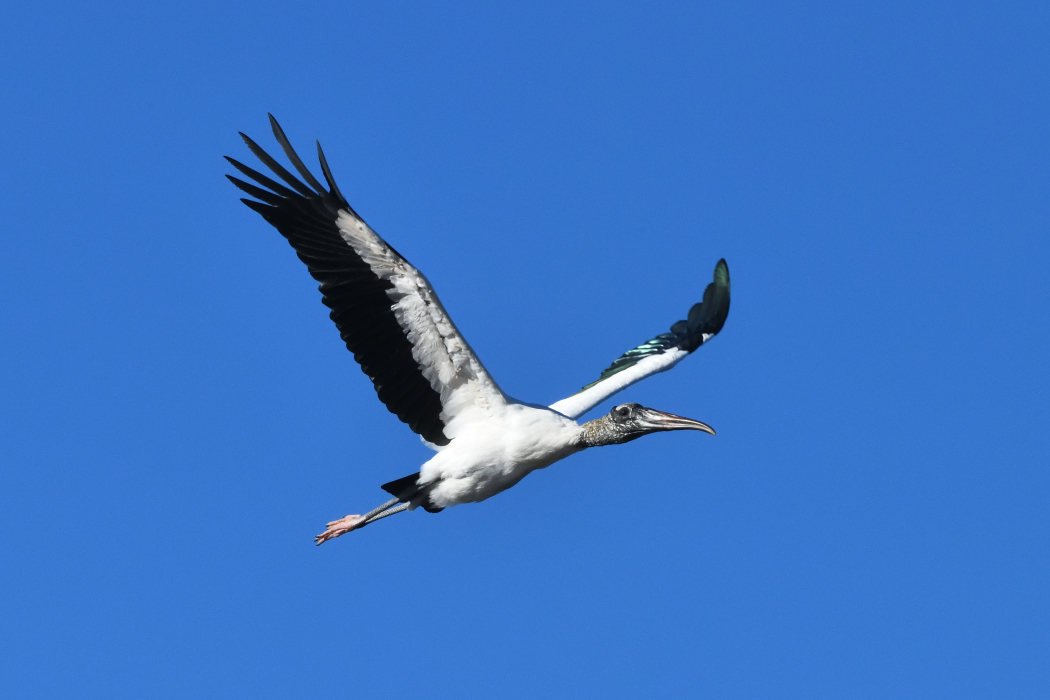
Several Wood Storks flew by while I watched an Anhinga in an adjacent pond with a Common Gallinule.
Other birds seen at the preserve included Pied-billed Grebe, Double-crested Cormorant, Great Blue Heron, Glossy Ibis, Northern Harrier, Red-tailed Hawk, Bald Eagle, Osprey, Killdeer, Willet, Wilson's Snipe, Eurasian Collared-Dove, Eastern Phoebe, Blue-gray Gnatcatcher, and Boat-tailed Grackle.
A Loggerhead Shrike and a Common Ground Dove were found perched in separate bushes along the east side of the preserve.
There was still no sign of the flycatcher. It looked like the cold front might have pushed the bird out and I was going to be making a long, depressing drive back to the motel. A little after 10:00, two birders from the Jacksonville area arrived. I walked around the south and west edge of the impoundment with them. I looked back towards the southwestern corner of the impoundment and spotted a Belted Kingfisher perched low on a stalk over the water. That's when I noticed a flash of white pass by the kingfisher. Further study eventually confirmed that it was the Fork-tailed Flycatcher! We walked all the way back to the other side and got some photos of it flycatching over its preferred area.
Amazingly, the bird eventually flew over to some brush right next to the parking lot and preened itself, unconcerned about us taking numerous photos of it.
I happily got back in my car and started the long drive back to the east coast. New trip birds seen along the highway included Western Cattle Egret and Sandhill Crane. At one point, I was stopped at a construction site behind a flatbed truck and laughed when I saw that there was a toy truck strapped to the back of it.
I got back to the motel a little after dark and went out to eat at a nearby Cracker Barrel.
Saturday, December 14, 2024
Florida Trip for Yellow-headed Caracara ~ December 13, 2024
Since the Gumbo Limbo Nature Center was close, I decided to give the Bananaquit one more try. I saw the same group of birds move through the Butterfly Garden as I did on the 11th. I got a few more photos of the Prairie Warbler.
There was still no sign of the Bananaquit. The best bird to show up was a light morph Short-tailed Hawk that perched in the dead snag above the garden.
It stayed there for about fifteen minutes before flying off to the north.
While I was there, I also got mediocre photos of a Giant Swallowtail and another of an Atala.
I had to be at the Fort Lauderdale Airport by 6:00 PM. Since Oleta River State Park was fairly close to it, I drove there for another chance at seeing the Caracara. That didn't happen, but I did get some photos of a Eurasian Collared-Dove that was there.
I returned the rental car with 592 more miles on it, flew back to Newark, drove home, and pulled into the garage at around 1:00 AM. I ended up with 58 species for the trip. More photos can be found in my Florida Photo Album.
Florida Trip ~ December 10-13, 2024
1) Pied-billed Grebe
2) American White Pelican
3) Brown Pelican
4) Anhinga
5) Double-crested Cormorant
6) Tricolored Heron
7) Little Blue Heron
8) Western Cattle Egret
9) Snowy Egret
10) Great Egret
11) Great Blue Heron
12) Wood Stork
13) Glossy Ibis
14) White Ibis
15) Turkey Vulture
16) Black Vulture
17) Osprey
18) Northern Harrier
19) Bald Eagle
20) Short-tailed Hawk
21) Red-tailed Hawk
22) Yellow-headed Caracara*
23) American Kestrel
24) Merlin
25) Common Gallinule
26) American Coot
27) Sandhill Crane
28) Killdeer
29) Willet
30) Wilson's Snipe
31) Laughing Gull
32) Ring-billed Gull
33) Lesser Black-backed Gull
34) Caspian Tern
35) Rock Pigeon
36) Mourning Dove
37) Eurasian Collared-Dove
38) Common Ground Dove
39) Ruby-throated Hummingbird
40) Belted Kingfisher
41) Eastern Phoebe
42) Fork-tailed Flycatcher
43) Loggerhead Shrike
44) Blue-headed Vireo
45) Blue Jay
46) Fish Crow
47) Blue-gray Gnatcatcher
48) Northern Mockingbird
49) European Starling
50) Northern Parula
51) Yellow-rumped Warbler
52) Black-and-white Warbler
53) Yellow-throated Warbler
54) Prairie Warbler
55) Palm Warbler
56) Northern Cardinal
57) Red-winged Blackbird
58) Boat-tailed Grackle
* Denotes a 'life bird'.
Wednesday, December 4, 2024
Cooper's Hawk at the Feeders ~ December 4, 2024
I have been swamped with up to 30 House Sparrows lately at my feeders. Unfortunately, they hog the feeders, making it tougher for the chickadees, titmice, and others to feed. This afternoon, I noticed all the birds scatter as an adult Cooper's Hawk zoomed in and perched on the fence.
I was rooting for him to take one of the House Sparrows, but he eventually flew off empty-handed.
Subscribe to:
Posts (Atom)


