Sunday, January 25, 1998

Texas Trip ~ January 15-16, 1998

January 15, 1998

Jason Horn, Rick Wiltraut, Dick Colyer, and I headed to south Texas for chances at some life birds. Our 28-hour drive got us to the gate of the El Canelo Ranch in the early morning hours on the 16th. The four of us uncomfortably slept in the car until morning.


January 16, 1998

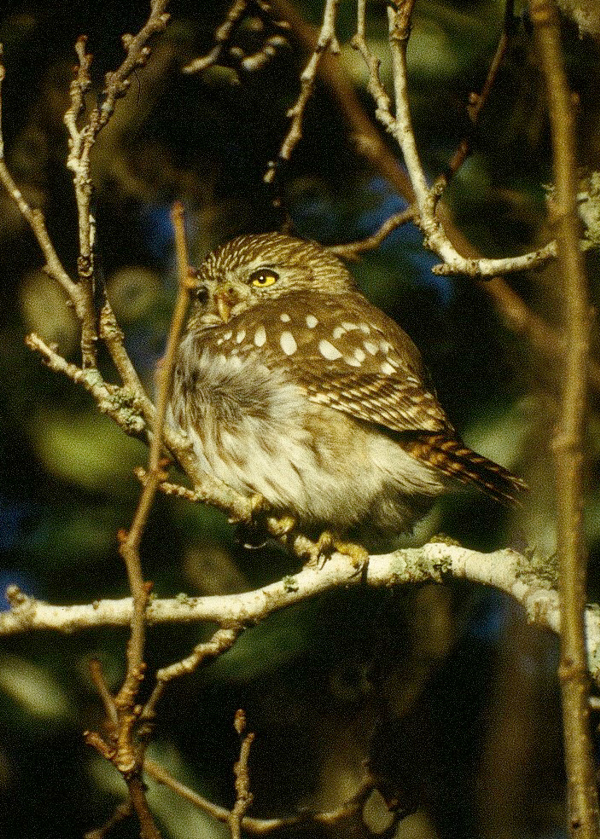
We drove in to the ranch house and walked into the backyard where the Ferruginous Pygmy-Owl was perched in one of the trees.
Ferruginous Pygmy-Owl at the El Canelo Ranch near Raymondville, Texas.


As we walked beyond the backyard, I noticed a male Phainopepla, which turned out to be a very unusual find for that area of Texas.
A male Phainopepla at the El Canelo Ranch near Raymondville, Texas.


Other birds seen at the ranch included Northern Harrier, Harris's Hawk, White-tailed Hawk, Crested Caracara, Northern Bobwhite, Sandhill Crane, Inca Dove, Common Ground-Dove, Barn Owl, Golden-fronted and Ladder-backed Woodpecker, Great Kiskadee, Green Jay, Cactus Wren, Curve-billed Thrasher, Loggerhead Shrike, Pyrrhuloxia, Vesper and Lark Sparrow, and Bronzed Cowbird.

We drove south to the Sabal Palm Sanctuary near Brownsville where we unsuccessfully looked for Tropical Parula. Birds we did see there were Mottled Duck, White-tipped Dove, Great Kiskadee, Green Jay, White-eyed Vireo, and Orange-crowned, Black-and-white, and Black-throated Green Warbler.

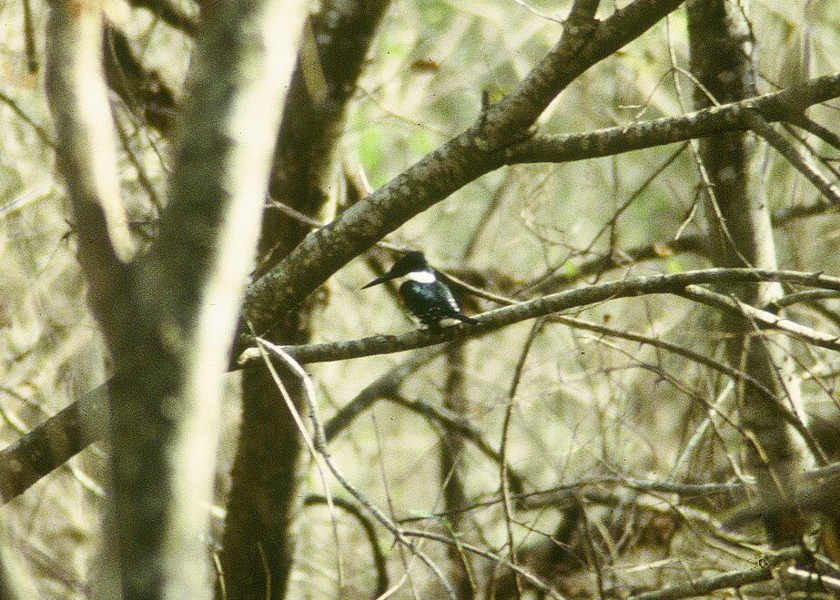
The next stop was Santa Ana National Wildlife Refuge, which held Neotropic Cormorant, Tricolored Heron, White-faced Ibis, Black-bellied Whistling-Duck, Mottled Duck, Peregrine Falcon, Plain Chachalaca, Sora, Black-necked Stilt, White-tipped Dove, Green Kingfisher, Couch's Kingbird, Green Jay, Orange-crowned Warbler, and Lincoln's Sparrow.
Green Kingfisher at Santa Ana National Wildlife Refuge in Texas.

Texas Trip ~ January 17, 1998

Our first stop was Bentsen - Rio Grande State Park. Birds found there included Hook-billed Kite, Harris's Hawk, Plain Chachalaca, White-winged, White-tipped, and Inca Dove, Common Pauraque, Golden-fronted Woodpecker, Great Kiskadee, Green Jay, Long-billed Thrasher, Blue-headed Vireo, Orange-crowned and Black-throated Gray Warbler, Black-headed Grosbeak, Indigo Bunting, Olive and Lincoln's Sparrow, and Altamira Oriole.

We returned to Sabal Palm Sanctuary, which produced some new birds for the day. They were Least Grebe, Mottled Duck, White-tailed Kite, Buff-bellied Hummingbird, Ladder-backed Woodpecker, Loggerhead Shrike, White-eyed Vireo, Yellow-rumped Warbler, Black-throated Green Warbler, Northern Parula, and, on this visit, my 'life' Tropical Parula.

Farther up the coast, we checked out Laguna Atascosa National Wildlife Refuge. New birds for the day included Eared Grebe, American White Pelican, Reddish Egret, White Ibis, Redhead, American Kestrel, Merlin, Peregrine Falcon, Sandhill Crane, Willet, Long-billed Curlew, Gull-billed and Royal Tern, American Pipit, and, surprisingly, a Townsend's Warbler.
Townsend's Warbler at Laguna Atascosa National Wildlife Refuge, Texas.

Texas Trip ~ January 18-19, 1998

January 18, 1998

A scan of the marsh from the large observation tower at Aransas National Wildlife Refuge revealed American White Pelican, Brown Pelican, Black-crowned Night-Heron, White Ibis, Roseate Spoonbill, King and Virginia Rail, Sora, Sandhill Crane, American Oystercatcher, American Avocet, Long-billed Curlew, and Forster's Tern, but I was happiest to see three adult Whooping Cranes, which was a new species for me.

On our way back home, we detoured to Anahuac National Wildlife Refuge. Notables there were American Bittern, Snowy Egret, Tricolored Heron, Roseate Spoonbill, White-tailed Kite, Merlin, Common Moorhen, Marsh Wren, Sedge Wren, and Savannah, Le Conte's, Seaside, and Sharp-tailed Sparrow.

White-tailed Kite at Anahuac National Wildlife Refuge, Texas.


Back on the road, we wanted to get something to eat before it got too late. We remembered that there was a Kentucky Fried Chicken restaurant somewhere near the Texas-Louisiana border, so we were aiming for that, but it kept getting later and we were wondering if we were going to get there before it closed. Eventually, Rick and Jason fell asleep in the back seat while Dick was driving. I was barely awake when Dick saw a billboard for the upcoming KFC. He was so happy to see it that he yelled, "Kentucky Fried Chicken!" Jason and Rick jumped up, figuring that we were about to go into a bridge abutment or something worse. As it turned out, we made it to the restaurant with about a half-hour to spare and cleaned out what was left of their buffet.


January 19, 1998

We took turns driving all through the night and the next day and finally got home late on the 19th. I got three life birds during another one of our "Red-eye Birding Tours".

Sunday, May 18, 1997

Florida Trip ~ May 2, 1997

This trip was designed to produce the best opportunities to see the majority of the Florida "specialties"---those birds that are generally only found in the state of Florida. It entailed a counterclockwise route of central and southern Florida, plus a drive down The Keys and a boat trip from Key West to the Dry Tortugas. I was very lucky to get Babe Webster to go along with me on this trip, especially since she had been there before on a Bucks County Audubon trip. Not only did I have the advantage of an extra pair of eyes, I had great company, which made the trip much more enjoyable. Being able to share the experience with someone else is always a plus.

After George brought Babe up to the house, my dad drove us to the L.V.I. Airport (formerly known as the A.B.E. Airport) where we boarded our 8:25 AM USAir flight to Charlotte, North Carolina. I had heard from several people that the Miami Airport was a "madhouse", so I got tickets to Fort Lauderdale instead. It turned out to be a good move. The airport wasn't crowded and we were still only a half-hour's drive from Miami anyway.

By the early afternoon, we were settled into our Hertz rental car and headed for the Hugh Taylor Birch State Recreation Area. It was here that a LaSagra's Flycatcher had been seen for several days. Unfortunately, we got there one day too late. It turned out that there was an air show scheduled nearby for the upcoming weekend; and low-flying jets didn't help our chances of finding the bird. We searched unsuccessfully for the flycatcher for several hours but did manage to find my first "lifer" of the trip---a Black-whiskered Vireo. It was a shame that we missed the flycatcher because it was one of the few birds that would have been new for Babe. Other birds that were seen there included White-winged Dove, Northern Parula, American Redstart, Common Yellowthroat, Cape May, Black-throated Blue, and Blackpoll Warbler, and Boat-tailed Grackle.

We left Hugh Taylor Birch and drove north to Loxahatchee National Wildlife Refuge. There, in the impoundment between Lee Road and the Marsh Trail, we found Wood Stork and Limpkin in addition to Anhinga, Little Blue and Tricolored Heron, Black-crowned Night-Heron, White and Glossy Ibis, Mottled Duck, Red-shouldered Hawk, Purple Gallinule, Common Moorhen, Pileated Woodpecker, and Loggerhead Shrike.

A Limpkin along the Marsh Trail at Loxahatchee National Wildlife Refuge, Florida.


A pair of Loggerhead Shrikes along the Marsh Trail at Loxahatchee National Wildlife Refuge, Florida.


A Wood Stork behind the visitor center at Loxahatchee National Wildlife Refuge, Florida.


At dusk, we left Loxahatchee and made the long drive to the Economy Inn in Sebring.

Florida Trip ~ May 3, 1997

We started the day by driving south to the Venus Flatwoods Preserve. On the way there, I saw my first Florida Scrub-Jay perched on a wire along Old Route 8 near the Archbold Biological Station.
Florida Scrub-Jay near the Archbold Biological Station, Florida.


When we finally reached the preserve, we heard, and then saw, a Bachman's Sparrow singing about four feet up on a pine branch. This turned out to be very lucky because the bird dropped down into the saw palmetto and was never seen or heard again during the rest of the time spent there.
Venus Flatwoods Preserve


Within a mile of the preserve, we saw Swallow-tailed Kite, Northern Bobwhite, Red-cockaded Woodpcker, Eastern Bluebird, and Rufous-sided Towhee.

Heading back north, we turned off Route 630 and parked along Walk-in-the-Water Road above Tiger Creek. It was here that I had hoped to see Short-tailed Hawk, but we never did find one. We apparently arrived too late to catch the birds "lifting off". We then tried the spot south of Route 630 along Rucks Dairy Road, but to no avail. Birds that were seen while searching for the Short-tailed Hawk included nice looks at a pair of Swallow-tailed Kites and Common Ground-Dove.
Swallow-tailed Kite along Rucks Dairy Road near Frostproof, Florida.


We then headed east to the south end of Lake Kissimmee. Although we didn't find the Snail Kites that we were hoping for, we did see Cattle Egret, Crested Caracara, and Sandhill Crane in farm fields along Route 60, just west of the lake. At Lake Kissimmee State Park, I got within 10 feet of a Sandhill Crane at the park entrance but still couldn't find a Snail Kite.
Sandhill Crane at the park entrance of Kissimmee State Park, Florida.


Returning southward on Route 27, we checked the spot east of Avon Park where Babe had seen Short-tailed Hawk on her previous trip but came up empty once again. From there, we drove to Clewiston where we searched in vain for Smooth-billed Ani.

The cruise control was then set as we took Route 80 west to the Motel 6 in North Fort Myers. There, I got excellent looks at a few Eurasian Collared-Doves on the roof of the motel.

Florida Trip ~ May 4, 1997

Our first birding stop of the day was the J.N. 'Ding Darling' National Wildlife Refuge. We took the Wildlife Drive and parked at "Stop #5" where we found a large gathering of Double-crested Cormorants and Great and Snowy Egrets, along with smaller numbers of Brown Pelicans, Tricolored Herons, Black-crowned and Yellow-crowned Night-Herons, and White Ibis. Also there, on the opposite side of the drive, were my first Roseate Spoonbills. It was also at this spot that I got bit by a swarm of 'no-see-ums'. Within minutes, it looked like I had the measles.
Yellow-crowned Night-Heron at the J.N. 'Ding Darling' National Wildlife Refuge, Florida.


Next, we searched around the Mangrove Overlook for Mangrove Cuckoo. Although I couldn't find it, we were amazed at the numbers of small crabs climbing around on the trunks and branches of the mangroves. Other birds that were found along the Wildlife Drive included American White Pelican, Anhinga, Little Blue Heron, Reddish Egret, Mottled Duck, Peregrine Falcon, Black-necked Stilt, Willet, Least Tern, Black Skimmer, and Pileated Woodpecker.
Reddish Egret at the J.N. 'Ding Darling' National Wildlife Refuge, Florida.


Immediately after leaving the Wildlife Drive and turning onto Sanibel-Captiva Road, we found a Gray Kingbird perched on a wire. While getting out of the car to get a better look at it, Babe suddenly discovered that she was standing in a group of fire ants. She moved as quickly as she could but still managed to get stung several times. I got a couple of stings while trying to get them off of her. The rest of the trip was spent looking down as well as up.

We left Sanibel Island and drove to Corkscrew Swamp Sanctuary.
Babe on the boardwalk at the Corkscrew Swamp Sanctuary, Florida.


Although we didn't see any of the Wood Storks the sanctuary is famous for, we did find Anhinga, Great Egret, Little Blue and Tricolored Heron, White Ibis, Red-shouldered Hawk, White-eyed Vireo, Northern Parula, and Pine Warbler. One of the highlights there was seeing the adult alligators with young in the swamp just off the boardwalk.
American Alligator along the boardwalk at the Corkscrew Swamp Sanctuary, Florida.


Along Route 858 southeast of Corkscrew, we stopped along the road to watch some Swallow-tailed Kites soaring over a woodlot. No matter how many times I saw this bird, it was still difficult not to stop whenever we spotted one. It is definitely near the top of my list of favorite birds. Next, we motored down Route 29 through the towns of Sunniland and Copeland, still hoping to find a Short-tailed Hawk soaring overhead. None were found, but we did see the signs and fencing along the road that mark the Florida Panther habitat area.

At the end of Route 29, we headed east on Route 41, also known as the Tamiami Trail. We were planning to stop at the Miccosukee Indian Restaurant for a meal, but it was closed. However, it was about a mile east of there at the air boat docks where I got to see my first Snail Kites. We watched them hover over the water, hunting for apple snails. One of the birds continually brought its catch back to a tree by the boat dock. We watched it stick its bill into the shell and pull out the snail and eat it.

Snail Kite at an air boat dock near the Miccosukee Indian Reservation, Florida.


We followed a large thunderstorm as we drove towards Miami. Luckily, it stayed far enough ahead of us as to not ruin the rest of our day. We continued east into Miami Springs and birded the area around the Fair Haven Nursing Home. There, we found Monk Parakeets in a tree containing their large nests plus American Redstart.

The Everglades Motel in Homestead was our final destination of the day. As we checked in, the owner proceeded to tell us his story about the night that Hurricane Andrew hit. He told us about the mobile home park that was located across the street and how it was completely gone the morning after. His concrete-walled motel fared a lot better than most buildings in the area.
Saturday, May 17, 1997

Florida Trip ~ May 5, 1997

Our plan for the day was to bird our way down to Key West. My first 'lifer' of the day turned out to be a Magnificent Frigatebird that circled over the bridge over the Intracoastal Waterway along US-1, north of Key Largo. Farther down The Keys, we spent a few hours searching Sugarloaf and Saddlebunch Keys for Mangrove Cuckoo. The fact that we were there in the middle of the day probably had a lot do to with us being unsuccessful. We did, however, find Common Ground-Dove, Gray Kingbird, Black-whiskered Vireo, Northern Parula, Prairie and Black-throated Blue Warbler, and Northern Waterthrush. On No Name Key, near Big Pine, we got within several feet of the tiny Key Deer.

Once we reached Key West, we headed for the corner of Flagler Avenue and 17th Terrace. This was the spot that the hotline had mentioned to look for Shiny Cowbird. While standing on the corner, we found several White-crowned Pigeons perched in a tree. It was then that Joe Ondrejko, the property owner, invited us into his house to watch his feeders. His property was like a miniature jungle, which provided great habitat for the birds. From his windows, we got excellent looks at Shiny Cowbirds and the White-crowned Pigeons.
Shiny Cowbird in Key West, Florida.


White-crowned Pigeon in Key West, Florida.


After another unsuccessful search for Mangrove Cuckoo at Little Hamaka City Park, we headed for the Lands End Marina where we secured a parking space of our car for the days that we were going to be on the Dry Tortugas boat trip. After eating, we drove to the Florida Keys Junior College on Stock Island, parked in the lot, and waited for dusk. It was there that I saw the Antillean Nighthawk. Its "fluttery" flight, like that of a bat's, was very different from our Common Nighthawk's.

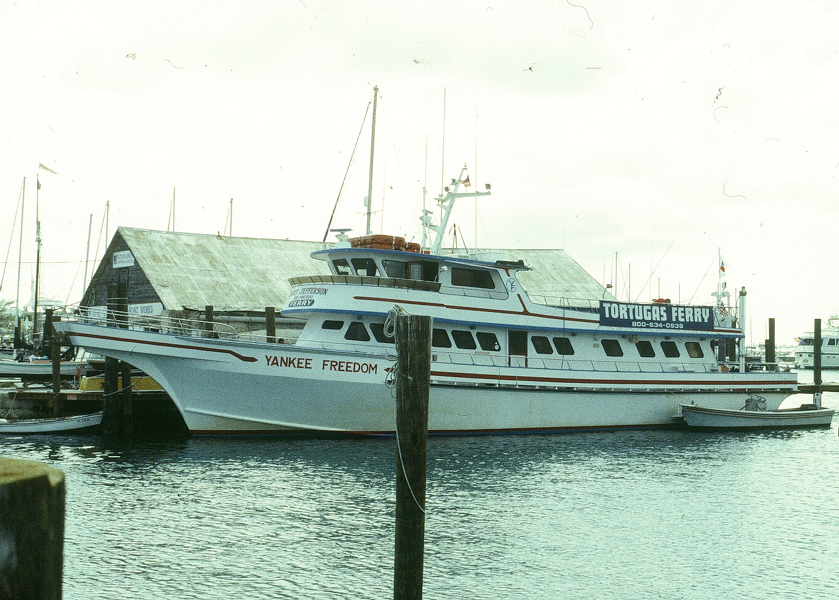
We returned to the marina and carried our things over to the "Yankee Freedom", our floating home for the next three days.