Saturday, May 17, 1997

Florida Trip ~ May 6, 1997

We were supposed to leave Monday night around 11:00 PM, but because our trip leader, Wes Biggs, was caught in a traffic jam near Miami, we spent the night at the dock and left early the next morning. On the way to the Dry Tortugas, we saw one adult and six immature Brown Boobies perched on a channel marker. Other birds spotted along the way were Northern Gannet, Magnificent Frigatebird, Pomarine Jaeger, and four species of terns that included Sandwich, Roseate, Least, and Bridled.

After docking at Fort Jefferson, we were taken in the skiff over to Bush Key. We saw four more species of terns comprised of Royal Tern and my first Brown Noddies, Sooty Terns, and a Black Noddy! Sooty tern chicks were seen at several spots along the shoreline. The Black Noddy was perched on a dead tree among the Brown Noddies, and a Peregrine Falcon was perched on a nearby snag.
Black Noddy on Bush Key in Dry Tortugas National Park, Florida.


We were also fortunate to witness a fairly good-sized migration 'fallout' on Garden Key. Birds spotted in and around Fort Jefferson included a Blue-winged Teal, Black-bellied and Semipalmated Plover, Lesser Yellowlegs, Spotted, Least, and Semipalmated Sandpiper, Ruddy Turnstone, Ruby-throated Hummingbird, Gray and Western Kingbird, Bank and Barn Swallow, Swainson's and Gray-cheeked Thrush, Black-whiskered Vireo, Indigo Bunting, Dickcissel, Bobolink, Shiny Cowbird, and fourteen species of warblers that included Magnolia, Cape May, Black-throated Blue, Yellow-rumped, Palm, Bay-breasted, Blackpoll, Black-and-white, Hooded, Northern Parula, American Redstart, Ovenbird, Northern Waterthrush, and Common Yellowthroat. Inside the fort, Cattle Egrets tried to ambush the weaker, small birds coming to the fountain for a drink. We had to be careful to not step on the scores of American Redstarts that were hopping around in the grass.

The inside and outside of Fort Jefferson in Dry Tortugas National Park, Florida.


One of the most exciting finds on Garden Key was that of a "West Indian" Short-eared Owl that was found roosting on a palm tree at the campground.
"West Indian" Short-eared Owl on Garden Key in Dry Tortugas National Park, Florida.


After reboarding the boat at the end of the day, it anchored on the west side of the fort. The boat rolled back-and-forth all night long as did my stomach while I was trying to sleep. I thought daybreak would never come.

Florida Trip ~ May 7, 1997

Our second day on the Tortugas began with us checking the fort for any new arrivals. The only two new ones that were found were a Peregrine Falcon and a Prairie Warbler.

The boat took us over to Loggerhead Key. There, we managed to find Sharp-shinned and Red-tailed Hawk, Merlin, Peregrine Falcon, Yellow-billed Cuckoo, Belted Kingfisher, Eastern Wood-Pewee, Black-whiskered Vireo, Rose-breasted Grosbeak, Indigo Bunting, Shiny Cowbird, and the same warbler species as the ones that were at the fort.

In the afternoon, I was taken in the skiff over to Long Key, where the only North American breeding colony of Magnificent Frigatebirds is located. There were lots of Magnificent Frigatebirds in the trees on Long Key and circling overhead.
Magnificent Frigatebirds on and over Long Key in Dry Tortugas National Park, Florida.


A young Magnificent Frigatebird near Long Key in Dry Tortugas National Park, Florida.


We got fairly close looks at the males inflating their red throat patches. A Yellow-crowned Night-Heron was also there along the shoreline.

Later in the day, the boat took us northeast to Hospital Key where we got to see Masked Boobies coming in to roost for the night. Also seen were Brown Booby and Magnificent Frigatebird.

After dark, the brightness of the Hale-Bopp Comet was surprising, as was the amount of stars that we never see since they are washed out by night lighting. We were sitting at a picnic table in the campground talking with Dick Novier, a friendly, Florida birder who was also one of guides on the trip when Babe noticed that the boat was leaving the dock about an hour ahead of when it was supposed to. Luckily, Babe was able to get a ride out to the boat on a skiff. I was planning to sleep on one of the picnic tables anyway (since I knew it wouldn't be rolling like the boat), but I never got the chance to get a pillow and blankets. So, I spent the night on the table wearing only my light jacket and using a box of "Ritz Bits" crackers as a pillow. Once again, it was a long night.

Florida Trip ~ May 8, 1997

Our last day on the Dry Tortugas was spent checking Garden Key for any different species that might have shown up during the night. The only new bird was a Black-throated Green Warbler. We also spent some time on top of the fort, hoping to find a White-tailed Tropicbird. While looking for this 'long shot', we had the always-present Magnificent Frigatebirds soaring overhead.
An adult male Magnificent Frigatebird over Fort Jefferson in Dry Tortugas National Park, Florida.


With everyone back on the boat, we headed for Key West. On the return pelagic, we saw Masked and Brown Booby, Royal and Bridled Tern, and Black Skimmer. Seeing the huge expanse of open water and the conditions the birds faced on the islands made me realize just how amazing it was that any of our migratory birds make it to their nesting areas. I was glad I had taken the Tortugas trip, but I was also glad to get off the boat and onto firm ground.

After piling everything back into our car, we headed back up The Keys. At one spot, we got nice looks at a "Great White" Heron. We reached the John Pennekamp Coral Reef State Park, on Key Largo, with very little daylight left. Just beyond the park entrance, we heard a Mangrove Cuckoo, but it stopped calling before we could find it. At dusk, we heard an Eastern Screech-Owl. However, since the cuckoos had apparently "called it a day", we decided to do the same by driving back to the Everglades Motel in Homestead.

Florida Trip ~ May 9, 1997

After talking over the situation, Babe willingly agreed that we should head back to Key Largo and try for the Mangrove Cuckoo first thing in the morning. A quick stop at the Burger King along US-1 south of SW 344th Street produced looks at Common Mynas. When we reached Pennekamp State Park, we took a walk down the Wild Tamarind Trail. Just past the point where the trail split, we heard what sounded like the call notes of the bird. Eventually, we determined it to be two different birds calling back and forth to each other. After some searching, Babe caught sight of the bird and directed me onto my 'life' Mangrove Cuckoo. I found it about three feet off the ground. It then flew up near the top of one of the trees where I got good looks at it highlighted by the sun.
Mangrove Cuckoo at the John Pennekamp Coral Reef State Park, Florida.


Hurricane Andrew's destruction was very evident along the way to Everglades National Park. There were many empty spaces where people never rebuilt; and whole woodlots were wiped out, leaving nothing left but patches of snapped-off tree trunks. Just inside the park entrance, we parked along the road to Taylor Slough. It was at this spot that a birder on the Tortugas trip had seen Short-tailed Hawks. We, however, weren't that lucky.

We headed down the park road toward Flamingo, making several stops along the way. We stopped at Royal Palm Hammock and walked the Anhinga Trail. There, we saw Double-crested Cormorant, Anhinga, Great "White" and Great Blue Heron, more American Alligators, and a Florida Softshell Tortoise.
Great "White" Heron at the Royal Palm Hammock in Everglades National Park, Florida.


Next, we stopped at Paurotis Pond, which held White Ibis and Wood Storks.
White Ibis at Paurotis Pond in Everglades National Park, Florida.


At Flamingo, we started to walk around Eco Pond but got inundated by a massive amount of mosquitoes. Back inside the car, we found all of the car windows covered with mosquitoes wanting to get in and started killing the bunch that did get in. We retraced our route back up the park road with stops at West Lake, Nine Mile Pond, and the area around Mahogany Hammock. Birds seen along the way included Brown Pelican, Tricolored Heron, Cattle Egret, Green Heron, Black Vulture, Swallow-tailed Kite, Bald Eagle, Red-shouldered Hawk, Common Tern, Yellow-billed Cuckoo, and White-eyed Vireo.

Our nest destination was the town of Kendall. On the way there, we stopped near Cutler Ridge and saw the "West Indian" race of Cave Swallow at the canal bridge over SW 216th Street. In Kendall, we stopped at the Furchgott's home, located at the corner of SW 96th Street and 69th Avenue. There, I saw my first Yellow-chevroned Parakeets and a pair of Spot-breasted Orioles in addition to Mitred Parakeets and Blue-crowned Parrots.

Next, we searched the area surrounding the Royal Palm Tennis Courts for Bulbuls. There, on the roof of a house located just outside the tennis club, I got to see my 'life' Red-whiskered Bulbul, thanks again to Babe. We returned to the Furchgott's home where I managed to get some pictures of the Spot-breasted Orioles.
Spot-breasted Oriole in Kendall, Florida.


Also found in the area were Monk Parakeet, Common Nighthawk, Chimney Swift, Purple Martin, Blue Jay, Northern Cardinal, and Common and Boat-tailed Grackle.

We returned to Homestead where we had a nice farewell dinner with Wes Biggs' group and spent our last night's stay at the Everglades Motel.

Florida Trip ~ May 10, 1997

We birded Loxahatchee National Wildlife Refuge before heading to the Fort Lauderdale Airport. It was my last chance to find a Smooth-billed Ani. Although we never found one, we did see Anhinga, Green and Great Blue Heron, Great, Snowy, and Cattle Egret, White and Glossy Ibis, Wood Stork, Mottled Duck, Fulvous Whistling-Duck, Red-shouldered Hawk, Common Moorhen, Limpkin, Black-necked Stilt, Yellow-billed Cuckoo, Great Crested Flycatcher, Loggerhead Shrike, Rose-breasted Grosbeak, and Bobolink. We were also surprised to see a Bobcat walking down the dike near the observation tower.
A Bobcat at Loxahatchee National Wildlife Refuge, Florida.


Sightings along the highway included Eurasian Collared-Dove, Gray Kingbird, and Purple Martin.

After returning the car with an additional 1400 miles on it, we boarded our flight in Fort Lauderdale and headed for Allentown by way of Charlotte. Of the 155 species seen during the trip, 23 were 'life birds'.


Florida Trip List

1) Pied-billed Grebe
2) Magnificent Frigatebird*
3) American White Pelican
4) Brown Pelican
5) Northern Gannet
6) Brown Booby*
7) Masked Booby
8) Anhinga
9) Double-crested Cormorant
10) Black-crowned Night-Heron
11) Yellow-crowned Night-Heron
12) Green Heron
13) Tricolored Heron
14) Little Blue Heron
15) Reddish Egret
16) Cattle Egret
17) Snowy Egret
18) Great Egret
19) Great Blue Heron (also Great "White" Heron)
20) Wood Stork*
21) Glossy Ibis
22) White Ibis
23) Roseate Spoonbill*
24) Sandhill Crane
25) Mottled Duck
26) Blue-winged Teal
27) Fulvous Whistling-Duck
28) Limpkin*
29) Virginia Rail
30) Purple Gallinule
31) Common Moorhen
32) American Coot
33) Black-necked Stilt
34) Semipalmated Plover
35) Killdeer
36) Black-bellied Plover
37) Willet
38) Lesser Yellowlegs
39) Solitary Sandpiper
40) Spotted Sandpiper
41) Ruddy Turnstone
42) Semipalmated Sandpiper
43) Least Sandpiper
44) Pomarine Jaeger
45) Laughing Gull
46) Common Tern
47) Roseate Tern
48) Least Tern
49) Sandwich Tern
50) Royal Tern
51) Bridled Tern
52) Sooty Tern*
53) Black Noddy*
54) Brown Noddy*
55) Black Skimmer
56) Turkey Vulture
57) Black Vulture
58) Bald Eagle
59) Swallow-tailed Kite
60) Snail Kite*
61) Sharp-shinned Hawk
62) Red-shouldered Hawk
63) Red-tailed Hawk
64) Osprey
65) Crested Caracara
66) Merlin
67) Peregrine Falcon
68) Northern Bobwhite
69) Wild Turkey
70) White-crowned Pigeon*
71) Rock Dove
72) Mourning Dove
73) White-winged Dove
74) Common Ground-Dove
75) Eurasian-collared Dove*
76) Yellow-chevroned Parakeet*
77) Monk Parakeet*
78) Mitred Parakeet
79) Blue-crowned Parrot
80) Mangrove Cuckoo*
81) Yellow-billed Cuckoo
82) Short-eared Owl ("West Indian" race)
83) Eastern Screech-Owl
84) Common Nighthawk
85) Antillean Nighthawk*
86) Chimney Swift
87) Ruby-throated Hummingbird
88) Belted Kingfisher
89) Red-bellied Woodpecker
90) Northern (Yellow-shafted) Flicker
91) Downy Woodpecker
92) Red-cockaded Woodpecker
93) Pileated Woodpecker
94) Eastern Kingbird
95) Gray Kingbird*
96) Western Kingbird
97) Great Crested Flycatcher
98) Eastern Wood-Pewee
99) Purple Martin
100) Bank Swallow
101) Cave Swallow ("West Indian" race)
102) Barn Swallow
103) Florida Scrub Jay*
104) Blue Jay
105) American Crow
106) Fish Crow
107) Tufted Titmouse
108) Carolina Wren
109) Blue-gray Gnatcatcher
110) Eastern Bluebird
111) Veery
112) Swainson's Thrush
113) Gray-cheeked Thrush
114) American Robin
115) Loggerhead Shrike
116) Gray Catbird
117) Northern Mockingbird
118) Cedar Waxwing
119) Red-whiskered Bulbul*
120) Common Myna
121) European Starling
122) White-eyed Vireo
123) Black-whiskered Vireo*
124) Northern Parula
125) Black-and-white Warbler
126) Black-throated Blue Warbler
127) Cape May Warbler
128) Magnolia Warbler
129) Yellow-rumped "Myrtle" Warbler
130) Black-throated Green Warbler
131) Prairie Warbler
132) Bay-breasted Warbler
133) Blackpoll Warbler
134) Pine Warbler
135) Palm Warbler
136) Hooded Warbler
137) Ovenbird
138) Northern Waterthrush
139) Common Yellowthroat
140) American Redstart
141) Rose-breasted Grosbeak
142) Northern Cardinal
143) Indigo Bunting
144) Eastern (Rufous-sided) Towhee
145) Bachman's Sparrow*
146) Dickcissel
147) Bobolink
148) Eastern Meadowlark
149) Red-winged Blackbird
150) Brown-headed Cowbird
151) Shiny Cowbird*
152) Common Grackle
153) Boat-tailed Grackle
154) Spot-breasted Oriole*
155) House Sparrow

Wednesday, November 13, 1996

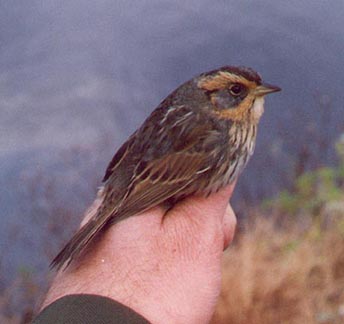
Sharp-tailed Sparrow in Northampton County! ~ November 12, 1996

Brian and Tiffany Hardiman found a Sharp-tailed Sparrow at Lake Minsi, Northampton County on November 11th. The next day, the bird was refound and netted and photographs were taken by Rick Wiltraut and Jason Horn.
Sharp-tailed Sparrow at Lake Minsi, Northampton County. Note the unstreaked gray nape, which helps separate this species from Le Conte's Sparrow. Also note the dark face patch bordered by an orange triangle and the white streaks on the back.


Sharp-tailed Sparrow at Lake Minsi, Northampton County. Note the gray crown stripe and the unstreaked gray nape, which separate this species from Le Conte's Sparrow. Also note the dark face patch bordered by an orange triangle, the dark streaking on the flanks and breast, and the white streaks on the back.


Sharp-tailed Sparrow at Lake Minsi, Northampton County. Note the gray crown stripe and the unstreaked gray nape, which separate this species from Le Conte's Sparrow. Also note the dark face patch bordered by an orange triangle, the dark streaking on the flanks and breast, and the white streaks on the back.


Sharp-tailed Sparrow at Lake Minsi, Northampton County. Note the unstreaked gray nape, which helps separate this species from Le Conte's Sparrow. Also note the dark face patch bordered by an orange triangle, the dark streaking on the flanks and breast, and the white streaks on the back.


Sharp-tailed Sparrow at Lake Minsi, Northampton County. Note the gray crown stripe, which helps separate this species from Le Conte's Sparrow. Also note the dark face patch bordered by an orange triangle, the dark streaking on the flanks and breast, and the white belly.


Obviously, this bird represents the 1st record for Northampton County and the Lehigh Valley area and one of a very few Pennsylvania records east of the Susquehanna River!

Monday, September 9, 1996

Black Skimmer in PA! ~ September 8, 1996

Rick Wiltraut and I traveled to Bald Eagle State Park in Centre County where a Black Skimmer was found resting on the public beach. Apparently, the passage of Hurricane Fran pushed it inland from its coastal home.
Black Skimmer at Bald Eagle State Park, Centre County. Hurricane Fran was most likely responsible for this bird leaving the coast. To my knowledge, this adult bird is the only Centre County record and one of less than 20 for the state of Pennsylvania.


It was a new state bird for both of us, making the drive home a lot more fun.