Saturday, May 30, 1987

Southeast Arizona Trip ~ May 20, 1987

We left Sierra Vista very early in order to reach Patagonia in the morning while most of the birds were still active. Birding early is essential for finding most desert birds. At the Patagonia-Sonoita Creek Sanctuary, we saw four Black-bellied Whistling-Ducks fly overhead, and a pair of Gila Woodpeckers were feeding among the large cottonwood trees. Broad-billed Hummingbirds were perched along the road at "Gate 3". The sanctuary was a good spot for flycatchers, which included Vermilion, Dusky-capped, Ash-throated, and Brown-crested Flycatcher, Black and Says' Phoebe, Western and Cassin's Kingbird, and Western Wood-Pewee. Warbler species included Yellow, Common Yellowthroat, and Yellow-breasted Chat. Other birds recorded there were Ladder-backed Woodpecker, Phainopepla, Summer Tanager, Blue Grosbeak, Rufous-sided and Brown Towhee, Bronzed and Brown-headed Cowbird, Lesser Goldfinch, and a 'lost' Indigo Bunting, which was a 'hotline bird' for Arizona birders.

We met some birders there who told us that they had seen the Rose-throated Becard earlier at the famous roadside rest below Patagonia. We headed down there, crossed the road, and joined the other birders already stationed there. After someone pointed out the old Becard nest to us, we waited for them to show up. Apparently, they were taking pieces of the old nest and building a new one somewhere farther back on the "Circle Z" property. While waiting for them, we got to see the Thick-billed Kingbird on its nest above us in the huge sycamore. While Babe and I were watching a Bewick's Wren going in and out of its nest hole, Mark spotted the male Rose-throated Becard and called us over in time to get a look at its bright throat color before it flew off again. We also saw Hooded Oriole back at the rest area. We left Patagonia's rest stop and went back to the sanctuary to look for the Gray Hawk. Although we did hear one in the thick cottonwoods, we weren't able to spot it.

We left Patagonia and headed for Kino Springs where the ponds held Black-bellied Whistling-Ducks and American Coots. Around perimeter of the pond were Brown-crested Flycatcher, Cedar Waxwing, and Western Meadowlark. We were on our way back to the Blazer without our 'target bird' when we heard the "pip-pip-pip" call that directed our attention to a small mesquite tree. There, in that tree, sat a pair of Tropical Kingbirds. We watched them as the rain started and the thunder roared. We got to the Blazer just as it started to pour.
Tropical Kingbird at Kino Springs, Arizona.


We continued down Route 82 towards Nogales in a torrential downpour, pulling off the road one time because I couldn't see. With the rain persisting, we checked in early to our Nogales motel and tried to catch up on some sleep. About an hour later, the skies partly broke. We drove up to the nearby Nogales Sewer Ponds and found more Black-bellied Whistling-Ducks. The rains were on and off, so we decided to go into Mexico. We parked on the U.S. side of the border and walked through customs into Mexico. Personally, after 15 minutes in downtown Nogales I was ready to get out of there. Street vendors were constantly hounding us to buy things while I saw someone digging through a garbage can for who-knows-what. The street intersections had no stoplights or signs, so drivers just pulled out whenever they thought it was their turn. We re-entered the U.S. and went back to our motel to recuperate.

Southeast Arizona Trip ~ May 21, 1987

Today's destination was California Gulch, a desolate canyon within a half-mile of the Mexican border. The 28-mile trip over rough, dirt roads and through streams took over two hours.
Ruby Road on the way to California Gulch, west of Nogales, Arizona.


On the way there, a pair of Golden Eagles took off from a roadside tree. Down in the canyon, we scoped the steep, surrounding hillsides and found a Rufous-crowned Sparrow. After more searching, we finally found one of the canyon's specialties, a Five-striped Sparrow, that was seen singing from a branch of ocotillo near the top of the hill. Farther down the so-called 'road' was a Rock Wren going to and from its nest located in a crevice in the rocks. Above where we parked was a singing male Varied Bunting. Other birds in the gulch were Gray-breasted Jay, Canyon and Bewick's Wren, Summer Tanager, Blue Grosbeak, and Hooded Oriole.

On the way back to I-19, we stopped at Pena Blanca Lake. We searched in vain for Montezuma Quail, one of the few birds we would not be able to find. We did see Ring-necked and Ruddy Ducks, Black Vulture, American Kestrel, Vermilion and Ash-throated Flycatcher, Bridled Titmouse, and Loggerhead Shrike. Once back on I-19, we stopped off and birded Santa Gertrudis Lane near Tumacacori where we saw Northern Cardinal and my first Pyrrhuloxia.

We drove on to Florida Wash (pronounced Flah-REED-ah, NOT like the state), at the base of Madera Canyon, and found Verdin, Phainopepla, Lucy's Warbler, Pyrrhuloxia, Varied Bunting, and Rufous-crowned and Black-throated Sparrow.
Black-throated Sparrow at Florida Wash near Continental, Arizona.


We continued on up to the Santa Rita Lodge where Broad-billed, Blue-throated, Black-chinned, and Magnificent Hummingbirds buzzed around the feeders.
Broad-billed Hummingbird at a feeder at the Santa Rita Lodge in Madera Canyon, Arizona.


Dusky-capped Flycatcher and Scott's Oriole were also present. We spent more time looking for Montezuma Quail with no luck. As dusk approached, we stationed ourselves under the telephone pole where the Elf Owl was nesting. Along with about 15 other birders, we waited until he popped his head out of the hole and eventually flew off into the woods. Then, we quickly moved across the road to where the Whiskered Screech-Owls had their nest in another pole. With the male calling from the woods, the female stuck her head out of the hole and looked around. We also heard a Whip-poor-will calling in the distance.

We left Santa Rita Lodge and headed back down the mountain to the arroyo above Florida Wash. This is where the Buff-collared Nightjars were being heard and seen. We carefully worked our way around and through the cactus, rocks, and fences to the edge of the arroyo. As we approached the arroyo, we could hear the strange call of the nightjar. Unfortunately, it stopped calling just as we got there. Poorwills were also calling, but again, we weren't able to see them. After standing in the dark for about a half-hour, we gave up and returned to the road. We drove into Tucson and spent the night there.

Southeast Arizona Trip ~ May 22, 1987

We went to the northwest section of Tucson to look for Bendire's Thrasher. While checking a few spots along Silverbell Road, we found Say's Phoebe, Brown and Abert's Towhee, Brown-crested Flycatcher, Cassin's and Western Kingbird, Verdin, Cactus Wren, Lucy's and MacGillivray's Warbler, Summer Tanager, Pyrrhuloxia, Curve-billed Thrasher, some Coyotes, and two non-poisonous snakes, but no Bendire's. Finally, along Silverbell Road near Sanders Road, we got an excellent look at a Bendire's Thrasher.

We later went to see the Saguaro National Monument full of huge saguaros with flowering tops. We stopped briefly at the Sonora Desert Museum, but it seemed so crowded that we decided not to go in.
Saguaro National Monument west of Tucson, Arizona.


We took Route 89 north out of Tucson and found two Zone-tailed Hawks circling against an overcast sky. The birds were silhouetted against the gray background, so the markings were hard to see. We would be lucky enough to get great looks at two other Zone-taileds later in the week. Also seen along the way to Aravaipa Canyon were Gambel's Quail, American Kestrel, Common Raven, and Phainopepla.
Aravaipa Canyon southeast Dudleyville, Arizona.


At the George Whittell Wildlife Preserve along Aravaipa Creek, we found a pair of Common Black-Hawks. One of them circled over their nest in a cottonwood tree, showing off its broad, white tail band. We also saw Scrub Jay, Lesser Goldfinch, and Hooded and Scott's Orioles along the creek. The desert scrub beside the little parking lot held a pair of Black-tailed Gnatcatchers.
The George Whittell Wildlife Preserve Aravaipa Canyon, southeast Dudleyville, Arizona.


We returned to Route 77 and went north to Dudleyville in order to find Mark's "hard luck" bird---Mississippi Kite. Just as we reached the town, I saw a kite-like bird flying over the road. We pulled over, jumped out, and watched an adult Mississippi Kite circle over the road. We ended up seeing three kites in about 15 minutes. We returned to Tucson where we found Inca Dove in one of the city parks.

Southeast Arizona Trip ~ May 23, 1987

We headed back to Madera Canyon in order to seek out some of the birds we had missed there before. We stopped at Florida Wash and found Band-tailed Pigeon, Ladder-backed Woodpecker, and Olive-sided Flycatcher among the usual species. Just above the bridge over the wash, Mark found a Botteri's Sparrow perched on an ocotillo stem. We watched it as it sang its bouncing song.
Botteri's Sparrow habitat just above Florida Wash near Continental, Arizona.


Along the stream near Proctor Road were Bell's Vireo, Wilson's Warbler, Western Tanager, and Scott's and "Bullock's" Oriole. Over the road back to the old dump, we got our first 'good' look at a Zone-tailed Hawk.

We went back to Tucson and the Reid Park Zoo to try and find the Ringed Turtle-Doves that were established there. We dipped on them, but the zoo was nice. We then went to the University of Arizona's main library where Cave Swallows were occasionally seen, but we found only Cliff Swallows and a Cactus Wren.

Back we went to the Florida arroyo to attempt to see the Buff-collared Nightjar. We happened to park next to the Field Guides tour vans. In the group were the Davidheisers, whom we talked with until it got closer to dusk. Near dusk, we again walked to the edge of the arroyo. Surprisingly, while it was still fairly light, the nightjar started calling. There, on a snag in the bottom of the arroyo, sat the bird! With its white throat patch and buffy collar, it appeared to have a complete ring around its neck. We watched it for at least a half-hour as it flew from perch to perch, sometimes playing in flight with the female. Again, Poorwills also called there, but once again, we never got a look at one.

Southeast Arizona Trip ~ May 24, 1987

This was our last day, so we decided to make our last efforts for the 'missed' birds. We had gone well above our expectations, but we still needed Montezuma Quail, Gray Hawk, Tyrannulet, and Rufous-winged Sparrow. Our plan was to go back to Pena Blanca Lake for the quail, go to Patagonia for the hawk and Tyrannulet, and try Wilmot Road in Tucson for the Rufous-winged.

First up was Pena Blanca Lake. Though we didn't find the quail, Mark found a male Costa's Hummingbird! This was a 'bonus' bird since it was one I never figured on getting on this trip.

The next stop was at the Patagonia roadside rest where we heard at least two Tyrannulets. I had one fly right over my head, but we couldn't find a perched one. There, we met Rich Stallcup, who was nice enough to tell us where a nest was at the Patagonia-Sonoita Creek Sanctuary. We followed his directions and within minutes were looking at a perched Northern Beardless-Tyrannulet.

We still couldn't find a Gray Hawk despite searching in the heavy foilage. As a last resort, I suggested driving down the main highway (Route 82) and searching the other side of the creek's cottonwoods. As we went down the highway, I luckily caught sight of a gray form against the green trees. It was a Gray Hawk perched in a large dead tree among the cottonwoods. We now left Patagonia with bigger smiles on our faces and headed back to Tucson once again.

We birded Wilmot Road, unfortunately in the heat of the day, and found Bendire's Thrasher but no Rufous-winged Sparrow. With some time to spare, we took a ride to the Sabino Canyon Recreation Area. On the east end of the city, we watched another Zone-tailed Hawk circle over the busy intersection. In addition to the expected birds at Sabino Canyon, we got to see the "Gilded" form of Northern Flicker on a wire next to the road. The other interesting thing was a Roadrunner that looked for handouts from the tram passengers.
The "Gilded" form of Northern Flicker at the Sabino Canyon Recreation Area near Tucson, Arizona.


Cactus Wren at the Sabino Canyon Recreation Area near Tucson, Arizona.


White-winged Dove at the Sabino Canyon Recreation Area near Tucson, Arizona.


After getting something to eat in Tucson, we packed up and boarded our flight for home with 61 life birds among a total of 170 species.


Southeast Arizona Trip List

1) Eared Grebe
2) Great Blue Heron
3) Green-backed Heron
4) White-faced Ibis
5) Black-bellied Whistling-Duck*
6) Mallard (and "Mexican" Duck)
7) Blue-winged Teal
8) Cinnamon Teal
9) Northern Shoveler
10) American Wigeon
11) Ring-necked Duck
12) Lesser Scaup
13) Ruddy Duck
14) Black Vulture
15) Turkey Vulture
16) Mississippi Kite
17) Northern Harrier
18) Cooper's Hawk
19) Northern Goshawk
20) Common Black-Hawk*
21) Harris's Hawk*
22) Gray Hawk*
23) Swainson's Hawk
24) Zone-tailed Hawk*
25) Red-tailed Hawk
26) Golden Eagle
27) American Kestrel
28) Prairie Falcon
29) Scaled Quail*
30) Gambel's Quail
31) American Coot
32) Killdeer
33) Black-necked Stilt
34) American Avocet
35) Baird's Sandpiper
36) Long-billed Dowitcher
37) Wilson's Phalarope
38) Rock Dove
39) Band-tailed Pigeon
40) White-winged Dove*
41) Mourning Dove
42) Inca Dove*
43) Greater Roadrunner
44) Flammulated Owl (heard only)
45) Whiskered Screech-Owl*
46) Elf Owl*
47) Spotted Owl*
48) Lesser Nighthawk
49) Common Poorwill (heard only)
50) Buff-collared Nightjar*
51) Whip-poor-will (heard only)
52) White-throated Swift
53) Broad-billed Hummingbird*
54) Violet-crowned Hummingbird*
55) Blue-throated Hummingbird*
56) Magnificent Hummingbird*
57) Black-chinned Hummingbird*
58) Anna's Hummingbird
59) Costa's Hummingbird*
60) Broad-tailed Hummingbird*
61) Elegant Trogon*
62) Acorn Woodpecker
63) Gila Woodpecker*
64) Ladder-backed Woodpecker
65) Hairy Woodpecker
66) Strickland's Woodpecker*
67) Northern Flicker ("Red-shafted" and "Gilded")
68) Northern Beardless-Tyrannulet*
69) Olive-sided Flycatcher
70) Greater Pewee*
71) Western Wood-Pewee
72) Western Flycatcher
73) Buff-breasted Flycatcher*
74) Black Phoebe
75) Say's Phoebe
76) Vermilion Flycatcher*
77) Dusky-capped Flycatcher*
78) Ash-throated Flycatcher
79) Brown-crested Flycatcher*
80) Sulphur-bellied Flycatcher*
81) Tropical Kingbird*
82) Cassin's Kingbird*
83) Thick-billed Kingbird*
84) Western Kingbird
85) Rose-throated Becard*
86) Horned Lark
87) Violet-green Swallow
88) Northern Rough-winged Swallow
89) Bank Swallow
90) Cliff Swallow
91) Barn Swallow
92) Steller's Jay
93) Scrub Jay
94) Gray-breasted Jay*
95) Chihuahuan Raven*
96) Common Raven
97) Mexican Chickadee*
98) Bridled Titmouse*
99) Verdin
100) Bushtit
101) Red-breasted Nuthatch
102) White-breasted Nuthatch
103) Pygmy Nuthatch
104) Brown Creeper
105) Cactus Wren
106) Rock Wren*
107) Canyon Wren*
108) Bewick's Wren
109) House Wren
110) Black-tailed Gnatcatcher*
111) Eastern Bluebird
112) Hermit Thrush
113) American Robin
114) Northern Mockingbird
115) Bendire's Thrasher*
116) Curve-billed Thrasher*
117) Crissal Thrasher
118) Cedar Waxwing
119) Phainopepla
120) Loggerhead Shrike
121) European Starling
122) Bell's Vireo*
123) Solitary Vireo
124) Virginia's Warbler*
125) Lucy's Warbler*
126) Yellow Warbler
127) Yellow-rumped "Audubon's" Warbler
128) Black-throated Gray Warbler
129) Townsend's Warbler
130) Grace's Warbler*
131) MacGillivray's Warbler
132) Common Yellowthroat
133) Wilson's Warbler
134) Red-faced Warbler*
135) Painted Redstart*
136) Yellow-breasted Chat
137) Olive Warbler*
138) Hepatic Tanager*
139) Summer Tanager
140) Western Tanager
141) Northern Cardinal
142) Pyrrhuloxia*
143) Black-headed Grosbeak*
144) Blue Grosbeak
145) Indigo Bunting
146) Varied Bunting*
147) Rufous-sided Towhee
148) Brown Towhee*
149) Abert's Towhee
150) Botteri's Sparrow*
151) Rufous-crowned Sparrow*
152) Chipping Sparrow
153) Black-throated Sparrow
154) Five-striped Sparrow*
155) Song Sparrow
156) Yellow-eyed Junco*
157) Red-winged Blackbird
158) Eastern Meadowlark
159) Western Meadowlark
160) Great-tailed Grackle*
161) Bronzed Cowbird*
162) Brown-headed Cowbird
163) Hooded Oriole
164) Northern "Bullock's" Oriole
165) Scott's Oriole*
166) House Finch
167) Red Crossbill
168) Pine Siskin
169) Lesser Goldfinch
170) House Sparrow

Sunday, September 21, 1986

Washington and British Columbia Trip ~ September 6, 1986

On Saturday morning, I boarded a plane in Newark for Seattle by way of Denver. I got my rental car and headed for Discovery Park near Seattle. On my way there, I stopped at the Ship Canal Marina and saw three Glaucous-winged Gulls on some pilings.
Glaucous-winged Gull at the Ship Canal Marina near Seattle, Washington.


The smell of evergreens filled the air at Discovery Park. At the North Parking Lot, the smaller and more nasal-sounding Northwestern Crows were present. They seemed very similar to our Fish Crows in size and call. From the lot, I hiked the Wolf Tree Nature Trail. There, I saw my first Black-throated Gray Warbler. Also there were Hutton's Vireo, Wilson's and Orange-crowned Warbler, Western Tanager, and the "Audubon's" form of Yellow-rumped Warbler. I left the park and headed south past the Space Needle for Mount Rainier. By now, the setting sun produced an orange glow on Rainier's snow-capped peak.

I stayed at a motel in Enumclaw, located near the base of the mountain.

Washington and British Columbia Trip ~ September 7, 1986

On Sunday, I headed for the Sunrise Visitor Center in Mount Rainier National Park. On the way up, frequent stops revealed Steller's Jay, "Oregon" Junco, Red-breasted Nuthatch, and Clark's Nutcracker.

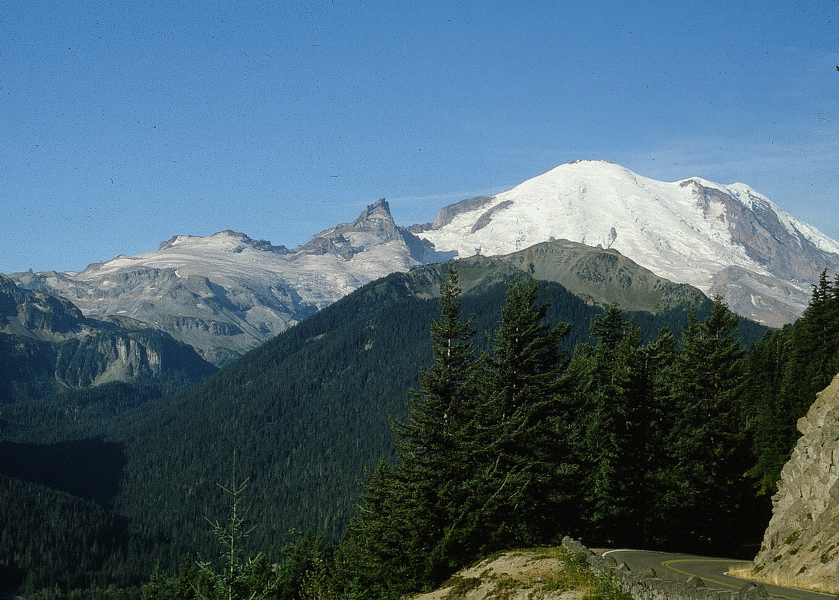
Mount Rainier from Sunrise Park Road in Mount Rainier National Park, Washington.


The Sunrise Visitor Center is located at the timberline, about 6400 feet in elevation. Along the treeline were Golden-crowned Kinglets. I hiked up from there into the alpine tundra. Hoary Marmots moved among the rocks.
A Hoary Marmot along the Burroughs Mountain Trail in Mount Rainier National Park, Washington.


About a mile up the trail, on First Burroughs Mountain, I found Horned Lark, Water Pipit, Common Raven, and a small flock of Gray-crowned Rosy-Finches.
A Water Pipit along the Burroughs Mountain Trail in Mount Rainier National Park, Washington.


There were amazing views in all directions as I headed for Second Burroughs Mountain and up to the snowline below Mount Rainier.
The White River from along the Burroughs Mountain Trail in Mount Rainier National Park, Washington.


The Burroughs Mountain area, dwarfed by Mount Rainier, from along the Burroughs Mountain Trail in Mount Rainier National Park, Washington.


Mount Rainier from the Burroughs Mountain Trail in Mount Rainier National Park, Washington. Note the trail just below center right that I took up to where the Ptarmigans were found.


Farther up, on Second Buroughs Mountain, I sat on a rock to take a break from the high-elevation hiking and take in the scenery. I was now just below the snowline and still hadn't seen my 'target bird'. After hearing something behind a rock about twenty feet from where I was sitting, I noticed a head pop out on one side of it. It was my 'life' White-tailed Ptarmigan!
A White-tailed Ptarmigan checking me out on Second Burroughs Mountain in Mount Rainier National Park, Washington.


Eventually, I found three of them as they allowed me to get some nice photos. Their plumage perfectly camouflaged them against the rocky background. Who knows how many more I didn't notice there?


White-tailed Ptarmigans blending in with their surroundings on Second Burroughs Mountain in Mount Rainier National Park, Washington.


It was tough to leave the Ptarmigans and the superb views. It was a long, but enjoyable, walk back to the car.
The view from 'the Ptarmigan spot' looking back towards the Sunrise Visitor Center in Mount Rainier National Park, Washington. The visitor center is behind the flat-topped peak. The cut for Sunrise Park Road is visible near center right.


On the way back down, I stopped at Shadow Lake, a tiny lake located just below the treeline, that produced Mountain Chickadee, Violet-green Swallow, and my first Gray Jays. Driving down from the visitor center, I stopped at Fryingpan Creek and found Vaux's Swifts overhead. I searched in vain for Three-toed Woodpecker at the Chinook Pass Summit and then turned off Route 410 onto Route 123. I spotted a single American Dipper diving into the water at the base of Silver Falls, located just above Ohanepecosh Campground. I headed east on Route 12 to the entrance to Oak Creek Canyon, just west of Naches, where I spent a restless night sleeping in the car.